
|
|
|
|
|
#1
 05-09-2013, 06:47 PM
|
|||
|
|||
|
Microprocessors in TV sets
Hello. I am not referring to modern tv's..but In the 70s and 80s, when electronic tuners and remote controls came into vogue, Did these TVs employ processors for the functions? I'd imagine the ones containing on screen menus and channel memory did. But, I once owned a General Electric with the LED channel readout (from 1980 or so) and the channel memory was non-volatile, it kept it's memory after being unplugged for years. Why would that be?
I get the feeling that a lot of cutting-edge-technology made its way into color TVs in the early 80s... Anyone care to discuss this? 

|
|
#2
05-09-2013, 09:39 PM
|
||||
|
||||
|
I bet the non-volatile memory you are describing, being so early, would use
ferrite toroids. Just a few bits would be required for channel info. Interesting topic, but I don't have any more info than you do. Regards.
|
|
#3
05-10-2013, 01:07 AM
|
||||
|
||||
|
Early electronic tuners usually did not need microprocessors. They used fairly simple digital logic if any. I'm also fairly certain some of the first OSDs did not use micro processors and could get away with simple custom logic.
In the early to late 70's sets were transitioning form tube to transistor to IC based designs and whatever was most economical went in. Micro processors would have made sets MUCH more expensive then. Some where on ARF's television forums years back someone had a late 70's Asian brand set which had mechanical tuners, tube sweep circuits, an ultrasonic remote, and an OSD from some custom chip the manufacturer had made. PS: TV remotes have been popular and in use since the mid 50's (Zenith came out with their Space Command system in 1955 IIRC), they just became more universal in the late 70's due to manufacturers making them standard in most models.
__________________
Tom C. Zenith: The quality stays in EVEN after the name falls off! What I want. --> http://www.videokarma.org/showpost.p...62&postcount=4
|
|
#4
05-10-2013, 10:37 AM
|
||||
|
||||
|
I think "computerized" may be a better way to look at it.
The first sets using digital tuning such as Magnavox "star system" had hi parts count not a single does it all micro. The star assy was big & probably had as many parts as the rest of the set. Things just evolved from there. In the late 70's more things got down to one or two IC's on a 6x6" board doing everything & more. Earlier sets with varactor tuners used mechanical switching (most) or electronic ( Sanyo, Toshiba prob others ). It switched between pots & band switches for each preset. For remote just add a motor or more electronics. The GE you spoke of was a real mongrel. Digital tuning done mechanically as I remember. I think it was only used on the hellish EC chassis & maybe AA-AB-AC. It may have also been a normal set-up. Memory very foggy on this, it was a rare bird. 73 Zeno
|
|
#5
05-10-2013, 02:44 PM
|
|||
|
|||
|
Interesting conversation here. It boggles my mind to think of the engineering which went into the early electronic tuners..pretty intricate stuff indeed..
Ferrite memory is something I'll have to look up. And yes the G-E I owned was always breaking down due to heat-related stress cracks in the solder points. Still to this day It has been difficult to find a TV with early O.S.D. .. from say, the early 80s or older.
|
| Audiokarma |
|
#6
05-10-2013, 06:24 PM
|
||||
|
||||
|
I think ferrite memory is likely something akin to what (in some applications) was called "magnetic memory".
I play (and sometimes do minor repairs on) a large electronic organ at my church. Made by Rodgers in the mid 70's, it has a magnetic memory system that Rodgers advertised as "computer combination action". The system used on our organ is quite odd, but it works well and has been very reliable.
|
|
#7
05-10-2013, 06:32 PM
|
|||
|
|||
|
Here's a 1976 Popular Mechanics article that talks about Magnavox Star and digital readouts: http://books.google.com/books?id=cuI...0tuner&f=false
I got a kick out of them explaining typing "04" for channel 4. I will say in my experience, and I was pretty young in the 70's, that I remember remotes being rather rare. I used to ride with my grandfather on service calls during the summers and I only remember people with high-end Quasar consoles with them. I remember clearly going with my dad in 1985 to shop for a new tv and the RCA dealer asking him if he wanted a tv with remote. My dad promptly replied, "no, that's what kids are for." I don't think they got remote until the early 90's when my sister moved away (lol)! About 1976 micro-processors and LED's/vac florescent displays must have gotten a lot cheaper because there was an explosion of them in products. Chrysler came out with the first digital tuned car radio in 1977 and the first computer controlled engine system. Early digital games like electronic football and Merlin came about then. Amana came out with the Touchmatic microwave and a lot of appliaces started getting digital readouts. GE came out with a programmable clock radio too. All before 1980. I guess engineers were pretty busy then.
|
|
#9
05-11-2013, 09:09 PM
|
||||
|
||||
|
Quote:
I seem to recall that the more exotic ferrite memory in computers had to be heated to the proper temperature for operation, but I'd guess that in jukeboxes, lower speed and less temperature dependence was the thing.
|
|
#10
05-16-2013, 06:47 PM
|
|||
|
|||
|
Quote:
Yup, my dad has one of the Seeburg jukeboxes with ferrite core memory. It basically used it to store the selection queue, instead of the mechanical switch bank and trip lever most jukeboxes used prior to that.
|
| Audiokarma |
|
#11
05-11-2013, 02:54 PM
|
||||
|
||||
|
Back in the late 70's and 80's chip makers made microprocessors that had built in RAM and ROM, the ROM could be "metal masked" with the programming. Metal mask was a final step in chip making, essentially a layer of wiring superimposed on the chip. Done when the buyer wanted a few hundred thousand of them.
__________________
|
|
#12
06-09-2013, 08:25 PM
|
||||
|
||||
|
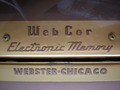
Another application of ferrite memories (outside proper digital computers of course)
was the HP 9100A desktop calculator (circa 1968). You could turn the machine off at any time, come back six months later and the same numbers would be on the display (after turning it on again, of course!).
|
|
#13
06-10-2013, 11:27 PM
|
||||
|
||||
|
I have a 19" Sharp color TV from around '73 that uses mechanical tuners, an ultra-sonic remote, and has OSD. The chassis is hybrid tube/transistor. Unfortunately, I've never been able to use it because the CRT is dead. It has a seperate board for OSD that has some IC's on it; but, I've never paid much attention to it. Here's the Sharp TV:
http://www.videokarma.org/showthread...ighlight=sharp
__________________
http://www.youtube.com/user/radiotvphononut Last edited by radiotvnut; 06-10-2013 at 11:38 PM.
|
|
#14
06-11-2013, 01:48 AM
|
||||
|
||||
|
Quote:
__________________
Tom C. Zenith: The quality stays in EVEN after the name falls off! What I want. --> http://www.videokarma.org/showpost.p...62&postcount=4
|
|
#15
06-12-2013, 12:28 AM
|
||||
|
||||
|
Quote:
Last edited by Jon A.; 06-13-2013 at 01:42 AM.
|
| Audiokarma |
 |
|
|









 Hybrid Mode
