
|
|
|
#1
 03-05-2023, 02:21 PM
|
||||
|
||||
|
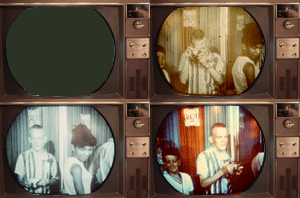
Re-creating "See Yourself on Color TV"
In the past few days I have experimented with hooking up a digital camera with NTSC output to my CTC-5 via a UHF modulator. The camera is an Olympus pocket point-and-shoot, model Stylus 710, 7.1 Mpixels. It has an NTSC output of the camera back LCD display. The camera has multiple resolution settings for the digital files, but they have no effect on the NTSC output. The camera back display shuts off when the dedicated cable is plugged in. The video coming out duplicates the camera back display with informative text and symbols that cannot be turned off.
The first trials yesterday, using available room light, showed terrible color, greenish faces, etc. I tried white balance settings to no avail. Today I brought out various color charts and discovered the problem was that the CTC-5 HUE adjustment (color phase, which RCA later called TINT) was way off. I suspect this is because the color subcarrier out of the camera is off frequency a fair amount, and the CTC-5 subcarrier loop suffers from low gain, and develops a large phase offset to pull the oscillator to the incoming frequency. Broadcast subcarrier tolerance was +/- 10 Hz, but it's doubtful the camera has a tolerance tighter than 100-150 Hz, maybe worse. I would have to hook up a frequency counter to the color oscillator in the TV to see what the frequency is with various sources, and of course I have no video source guaranteed to meet broadcast tolerance. With hue adjusted, the color was reasonable. Other than the hue issue, the picture showed the same gray scale tracking, resolution, and brightness issues that the CTC-5 always does. The next step in picture improvement would be to add some dedicated lighting, but I don't want the clutter in my living room and put everything away. 
|
|
#2
03-05-2023, 03:18 PM
|
||||
|
||||
|
Note: I forgot that the CTC-5 Super chassis uses an injection-locked oscillator instead of a PLL, but the principle is the same - except that the phase shift vs. frequency offset depends on the burst injection level rather than DC control loop gain.
|
|
#3
03-05-2023, 05:52 PM
|
||||
|
||||
|
The Hitachi/ RCA CKC-020 handcam is cheap and cheerful composite "live" color video for the non-technically adept, ime they almost always work well. What is required is the special cabling and power supply terminal unit that accomedate the standard home video camera connector on the separable cable, and a $12 unbranded RF modulator, all can be found in the usual on-line flea market place. The CLC version is autofocus, a bit bulkier and more complex with a smaller viewfinder monitor.
__________________
Goodness comes from getting the basics right, glory is to be found in tending to the details. Last edited by Pio1980; 03-05-2023 at 06:15 PM.
|
|
#4
03-05-2023, 08:00 PM
|
||||
|
||||
|
Quote:
__________________
Goodness comes from getting the basics right, glory is to be found in tending to the details.
|
|
#5
03-05-2023, 08:18 PM
|
||||
|
||||
|
Quote:
|
| Audiokarma |
|
#6
03-05-2023, 10:35 PM
|
||||
|
||||
|
A 1970 paper by Norman P. Doyle of Fairchild semiconductor compared three types of transistor subcarrier regeneration circuits: PLL, injection lock, and ringing. Tube circuits should have similar performance if designed using similar parameters.
For 100 Hz frequency offset, the PLL phase shift was approximately 3 degrees, the injection lock approximately 16 degrees, and the ringing circuit approximately 34 degrees. At 200 Hz, the numbers were approximately 5, 30, and 65 degrees, respectively. Note that +/- 5 degrees was the generally accepted tolerance for hue stability that would not prompt customer adjustment. I estimate the shift I saw on the color chart was at least 45 degrees. Of course, these numbers could vary with design, but not too extremely, because of the need to control other characteristics of the circuits like noise bandwidth and pull-in range.
|
|
#7
03-31-2023, 09:01 PM
|
||||
|
||||
|
I acquired a few pieces of gear (camera, backdrop, and lighting) and refined the setup.
If I get the chance to host the camera club this summer for a table-top photo session (on hold for three years due to pandemic and personal health issues), I'll set this up as a little extra surprise. Latest result: https://www.youtube.com/watch?v=fv4cknI_iOA Full details of setup: https://www.flickr.com/photos/old_tv...77720307154276
|
|
#8
04-01-2023, 03:23 PM
|
||||
|
||||
|
Here's a retake of the results, with correct camera exposure and some highlight, shadow, and color temperature adjustment in Adobe Premier Rush.
https://www.youtube.com/watch?v=KtX97emDuo8 Last edited by old_tv_nut; 04-01-2023 at 05:29 PM.
|
 |
|
|




 Linear Mode

