
|
|
|
|
|
#2
 07-03-2013, 06:54 PM
|
||||
|
||||
|
You hyave not shown us the date code, so it is hard to say. The date code is a 3 digit unumber like 514... meaning 1955, 14 th week. Unless I am mistaken :-)
__________________
John Folsom 
|
|
#3
07-03-2013, 09:52 PM
|
||||
|
||||
|
some have 4 digit numbers 55 14 etc at least that's how my cyp crt is
__________________
"It's a mad mad mad mad world" !! http://www.youtube.com/user/mwstaton64?feature=mhee
|
|
#5
07-04-2013, 08:37 AM
|
||||
|
||||
|
Quote:
73 Zeno 
|
| Audiokarma |
|
#6
07-04-2013, 10:59 AM
|
||||
|
||||
|
If I read the tube type # on the neck correctly, it's a 21AXP22A. Which is not original to the 21CT55 receiver. Still, the build date info would be interesting.
-Steve D.
__________________
Please visit my CT-100, CTC-5, vintage color tv site: http://www.wtv-zone.com/Stevetek/
|
|
#7
07-04-2013, 12:10 PM
|
|||
|
|||
|
Quote:
|
|
#10
07-04-2013, 02:35 PM
|
||||
|
||||
|
Your keyway number makes sense. One of my AXP's that I can easily get to now has a S/N of AC69535 and stamped 57-26 on the keyway.
Here is part of what Lud Sibley wrote about RCA CRT date codes. The number on our tubes seem to have an additional letter in the beginning and does not match his codes so it is hard to know how to translate it exactly. Year letters were: 1944 H 1949 J 1953 T 1957 S 1961 N 1966 Z 1970 P 1945 A 1950 C 1954 X 1958 K 1963 F 1967 U 1971 Y 1947 N 1951 Z 1955 R 1959 H 1964 J 1968 T 1972 S 1948 F 1952 U 1956 Y 1960 A 1965 C 1969 X 1973 K Note the ambiguous 15-year repeat of the letters, except for "P" and "R." The month-number and year-letter sequence was reversed each month. For example, "C6" designates Nov. 1950, whereas "6C" designates Dec. 1950. FOR SPECIAL PURPOSE TUBES High-value power and cathode-ray tubes carried serial numbers. The serial identification was a year letter plus a five digit number. The year letters for 1944-73 were the same as shown above for metal tubes, plus the following (reflecting the later demise of the Lancaster power-tube plant compared to Harrison). 1974 H 1977 N 1980 C 1975 V 1978 F 1981 Z 1976 A 1979 J 1982 U The number part of the identification reverted to "1" at start of a new year, at least on types like the 858B. On some types like 869B, the serial number substituted for a date-of-manufacture code. (S. N. 27-1-1A, p. 3 [6-14-57 and 12-1-69]).
__________________
Tim
|
| Audiokarma |
|
#11
07-08-2013, 10:13 PM
|
||||
|
||||
|
Quote:
Where can I find the rest of his codes? I had been wondering if any of my 5TP4's were replacements. All were from TVs manufactured in 1949 (although one carried a 1948 model number.) No letters found, except on the neck glass. (NEB, JEC, MEB & unmarked) However, the back of the light-brown bases carried open date codes: 9-39 9-48 0-35 0-43 Ouch! So at least two were replaced the first year! Sorry for posting a B&W question in the color forum, but I guess there is precedence. When the 15GP22 and 15HP22 first came out and no service shop had a color CRT tester, the instructions to test either was to use the 5TP4 setting and wire up jumper clips directly on the CRT socket for each gun. James
|
|
#12
07-04-2013, 06:57 PM
|
||||
|
||||
|
Steve is right, that tube would have to be a replacement since it's the 'A' version. See the red dag on the inside? It has a resistance to it, so it can be used with chassis not having the series resistance in the anode lead. The 21-CT-55 had an extra anode lead with the resistors in it, the CTC-4 had them built into the HV tower connection on the chassis. These served as arc-over protection for the flyback, but when the 'A' version of the tube came out they were no longer necessary. Hence chassis using the 'A' version had no series resistors, as they were in effect built into the CRT. It would be a very bad idea to use a non-A 21AXP22 in a chassis without series resistors, there would be no protection at all from arcing.
__________________
Evolution... 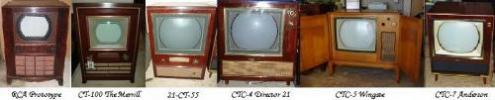
|
|
#14
07-05-2013, 08:30 AM
|
|||
|
|||
|
Quote:
Also other firms building color sets were buying RCA CRT's at the time.
|
|
#15
07-08-2013, 11:39 PM
|
||||
|
||||
|
__________________
Tim
|
| Audiokarma |
 |
|
|







 Hybrid Mode
