
|
|
|
#1
 10-11-2009, 09:43 PM
|
||||
|
||||
|
oddball roundies
I'm not talking about super-rare 15" prototype sets, CT100s, or that remote controlled ctc-7, but just round screen color sets that are seldom seen and have been pretty much forgotten even by us tv nuts. For example, I was just flipping through some old sams, and came across a 1964 Muntz combo (I had no idea Muntz even made a color set) It just used an RCA chassis, but what surprised me was that the radio was hardly 'muntzed' at all with 6 speakers and push-pull output. Anyone ever come across a Muntz, or a similarly unusual (but not necessarily sought-after) roundie?

|
|
#2
10-11-2009, 10:48 PM
|
||||
|
||||
|
I have some ads for lesser brands, but I'm not enough of a collector to have come across any. Would love to see an Andrea bare chassis (meant for custom installation) or even a Heathkit color roundie.
|
|
#4
10-12-2009, 01:37 AM
|
||||
|
||||
|
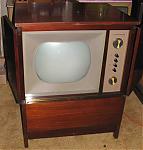
This is a Muntz CTC-5 clone from 1957. The chassis is a RCA built CTC-5, the cabinet is really cheap, probably built by Muntz. It has a Muntz model number and tube chart. RCA was more than happy to offer clone sets to many manufacturers over the years to bolster the number of color TVs in the hans of TV viewers.
__________________
John Folsom
|
|
#5
10-12-2009, 10:32 AM
|
||||
|
||||
|
Did Setchell-Carlson ever make a roundie with its modular "unitized" chassis?
I've seen rectangular sets with the chassis. Maybe this was one? http://www.listown.com/electronics/ny/200908/508771.htm
|
| Audiokarma |
|
#6
10-12-2009, 02:38 PM
|
||||
|
||||
|
Yes, I have seen a unitized S-C roundie. It worked well; the owner said a friend of his had one, too. Wish I had stayed in touch. (it wasn't local)
Somebody in the VK family has a 60s Muntz color set, but I think it's a 23v. Lots of neat stuff if you browse through the Sams. Everybody offered at least a clone.
__________________
Bryan
|
|
#7
10-12-2009, 03:17 PM
|
||||
|
||||
|
When you browse through the Sams folders there are thousands of different models of all brands, however in real life (and eBay) you only seem to find the same few dozen models for sale, and the color sets are mostly Zenith and RCA, what happened to all those millions of sets?
Never mind, I know, they hit the landfill for the most part and only the most common models survived in any quantity. 
|
|
#8
10-12-2009, 10:13 PM
|
||||
|
||||
|
I was walking through the woods one day and pretty far back from the house I found the TV dump that my old neighbor had. He was a retired Sears repairman. Lots of Silvertone TVs, of course, and also an Olympic roundie with a bullet hole through the center of the crt

__________________
Bryan
|
|
#9
10-12-2009, 10:22 PM
|
||||
|
||||
|
I once had an Olympic roundie combo. Haven't seen another Olympic color set, though I've seen a lot of B/W ones over the years.
__________________
Dumont-First with the finest in television.
|
|
#10
10-14-2009, 09:29 PM
|
||||
|
||||

Did that Muntz in the photo use a 'Special' chassis, or the DeLuxe version?
|
| Audiokarma |
|
#11
10-14-2009, 09:56 PM
|
||||
|
||||
|
The Muntz uses the DeLuxe chassis. You might think Muntz would go for the cheapest option. But maybe they mad up for it with the extra cheap-o cabinet!
__________________
John Folsom
|
|
#12
10-15-2009, 12:07 PM
|
||||
|
||||
|
RCA Model for Custom Installation.
Quote:
RCA made a special model for custom installation inside the wall of a house. I have never been able to re-find its model number or name. I did see a catalog page as a kid. It had the standard receiver front (with controls to the right of the crt face), and the chassis mounted on a bottom plate. It may have had a protective wrap around the chassis. It had audio output for use of an external audio amplifier. It was likely a CTC9, CTC10, or CT11. Does anyone have any information? Ed Reitan
|
|
#14
10-16-2009, 07:59 PM
|
||||
|
||||
|
I would be interested in finding an old Hoffman set.
They had a different scheme for preserving the higher bandwidth in the orange-cyan range. Rather that separate I-Q detectors followed by an amp and delay line for the I signal like the early RCA's, they used a full-bandwidth colour channel with the extended frequency portion of the subcarrier delayed so they could use R-Y, G-Y and B-Y detection. It would be interesting to see if this actually worked.
|
|
#15
10-16-2009, 08:08 PM
|
||||
|
||||
|
Quote:
|
| Audiokarma |
 |
| Thread Tools | |
| Display Modes | |
|
|










 Linear Mode

