
|
|
|
#1
 06-28-2016, 10:47 AM
|
||||
|
||||
|
Cataract removal question
1968 Motorola 25ZP22
Green halo Instructions on web for "RCA" type and "Zenith" type CRT differ. Motorola appears to have a "Zenith" type cataract (green) Am a bit nervous about methods involving heat, but have plenty of time. Will the soak method work for me, or does it only apply to RCA? Would be no problem to remove CRT and place into a kiddie pool in the garage. I could leave it all summer, the truck doesn't need to be indoors until it snows. 
|
|
#2
06-28-2016, 12:58 PM
|
||||
|
||||
|
Heat & pry as well as soak methods are for RCA type cats (the white/moldy ones) only. For Zenith type cats (green halo) the guitar string method is the way to go...Some run high current through the wire to help the process, but if you let it have direct sun on a hot-ish summer day you can probably do it with cool wire.
Here is a video of one of three Zenith cat removals I did.
__________________
Tom C. Zenith: The quality stays in EVEN after the name falls off! What I want. --> http://www.videokarma.org/showpost.p...62&postcount=4
|
|
#3
06-28-2016, 02:14 PM
|
||||
|
||||
|
Quote:
|
|
#4
06-28-2016, 03:11 PM
|
||||
|
||||
|
It is easy. Prep involves removing the CRT from the set and peeling off the tape over the glue....One tip, if you are careful not to damage the convergence board, it can be easier to leave the neck hardware on the tube....The CRT in the video was in a well adjusted watcher the day before...I left the neck hardware on and at the end was able to drop it back in the set with no new adjustments to it, and all was well.
Getting the glue off after removing the safety glass is the hard part....Sometimes. The previous tubes (a 60's Zenith 21FJP and a 1967 25AP out of an Admiral) were fairly easy, but the one in the video had a large extremely stubborn patch of glue in the center that took a lot of effort to clean off. Personally I find Zenith tubes easier to remove the glass from since I don't have to wait for the glue to gradually let go a bit and keep re-tightening wedges (I tend to get impatient and crack the glass trying to speed it up) or spend months letting it soak like those RCA CRTs.....Speaking of which I need to do another RCA cat soon...I'm going to be occupied in the coming week or two so I'm hoping to set it in the drink in a couple of days and see how water works first hand.
__________________
Tom C. Zenith: The quality stays in EVEN after the name falls off! What I want. --> http://www.videokarma.org/showpost.p...62&postcount=4
|
|
#5
06-29-2016, 11:57 AM
|
||||
|
||||
|
Alright, I have some thoughts on this going forward.
First, after watching a half dozen YouTube videos of imploding CRTs, I am convinced that the level of personal protective equipment in that video is almost reckless. No TV is worth risking a disfiguring injury! Secondly, I was thinking about how by removing the PVA, I will be essentially removing a safety feature deemed necessary for the product to be sold. Since I plan to use the Motorola in a house I share with other family members, I worry that defeating a safety feature puts them at an unnecessary risk. I was looking into optically clear adhesives I could use to reattach the safety glass and a friend made an interesting suggestion. 3M window security film.. If I put that on the face of the CRT, it should bind it together in the case of an implosion. The safety glass could be reattached as is usually done. What do you guys think, worth a try? Ideally I would have some dud CRTs I could use for destructive testing to prove it works, but I am thinking it can be better than nothing.
|
| Audiokarma |
|
#6
06-29-2016, 12:39 PM
|
||||
|
||||
|
in the round tube era new sets were sold with either a 21FBP22 or a 21FJP22. The 21FJP22 glued the lens, on but The 21FBP22 did not glue the glass to the CRT. It was instead held on with the CRT mounting and a rubber spacer/anti-dust gasket. If the 21FBP was safe enough for consumers, then changing a FJP to an FBP glass mount should be just as safe as other consumer sets made with the FBP. After removal I always add foam spacers at the edges and caulk the safety glass back on at edge of the glass....It is just as safe as the non-bonded safety glass CRTs of the day.
That film probably won't work...The glass is not curved exactly to the CRT face, and you will find there can be as much as 1/4" difference between the center and the edges when the safety glass is pressed directly against the CRT. Lastly I was a poor college student during the making of that video. I did not own ANY PPE, nor could I afford any....Also that was the hottest week of the summer so if I was in anything more covering than that I'd have died of heat stroke...I rather have a 3%* chance of death by CRT than an 85% chance of heat stroke. *If that!...a ways earlier I botched an RCA cat (sun method) and set the baking hot tube into a cold pool of water, realized the danger as soon as I did and decided to run...10-30sec later there was a pinging sound followed by hissing and water bubbling...The CRT face had 3 big cracks across it and had NOT imploded. Unless you are doing one of the infamous 23EGP22s or heating/cooling it fast/unevenly, or beating on it with a blunt implement implosion is very difficult to achieve...Even if you are trying. TV CRTs have been around since the 40's, and every year designs were becoming more implosion resistant...By 1960 you practically had to be trying to FORCE the average tube to implode for it to actually happen....Hell by 1973 the same CRT envelopes traded the glass and glue for a steel strap around the edge as the only external implosion protection.
__________________
Tom C. Zenith: The quality stays in EVEN after the name falls off! What I want. --> http://www.videokarma.org/showpost.p...62&postcount=4
|
|
#7
06-29-2016, 04:07 PM
|
||||
|
||||
|
I was thinking to use the single sided type of film, applied to the CRT face, and then use foam or rubber tape with an air gap to suspend the safety glass off the surface, and caulk around the edge. I kind of figured it wouldn't be a precision fit.
I didn't mean to be hard on you about lack of PPE, thinking more so from the perspective of the relative value of a CRT versus damage done by flying glass. . There's a video on youtube where someone in some foreign country throws a piece of metal at a CRT and it goes off like a bomb, sending glass all over a patio. Also, the infamous Motorola tube which was documented here on VK.
|
|
#8
07-01-2016, 04:25 PM
|
||||
|
||||
|
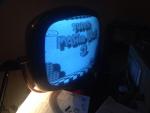
Cataract removed successfully!
Exactly like you did it, no power through wire. My wire broke a couple times too, I just got some random used strings from a guitar player, next time need thicker ones. Left it to sit outside for an hour or so to heat up. Like you, clean up was the worst part by far. The safety glass took a lot of scrubbing with acetone, water and eventually windex. Looks good now though. Arctic PPE was insanely hot on July 1st but gave me some piece of mind during process.
|
|
#9
07-01-2016, 04:35 PM
|
||||
|
||||
|
Nice work.
__________________
Tom C. Zenith: The quality stays in EVEN after the name falls off! What I want. --> http://www.videokarma.org/showpost.p...62&postcount=4
|
 |
| Thread Tools | |
| Display Modes | |
|
|





 Linear Mode

