
|
|
|
#16
 04-08-2011, 08:50 PM
|
||||
|
||||
|
I moved my connection over to the yoke and it works much better. There's still a little hum in the audio and the picture twists a little at the top.
Yes, the video does feed into the cathode. I agree some of the blanking pulse is feeding into the sync and audio circuit. I'll do a little more experimenting. P.S. I did get a little jolt from the VOT  

|
|
#17
04-08-2011, 09:08 PM
|
||||
|
||||
|
So I move the chassis and the cabinet down into the basement yesterday, clean up the top of the chassis a bit, and touch up the cabinet some. Then, just now, I put it together and all I get is a blank raster, no sound. aargh!!
 , so now it's back upstairs with the chassis, so I can figure out what else went wrong. , so now it's back upstairs with the chassis, so I can figure out what else went wrong.
|
|
#18
04-08-2011, 11:02 PM
|
||||
|
||||
|
Aw nuts
 I hope it's something simple like a loose tube in the tuner. I hope it's something simple like a loose tube in the tuner.
|
|
#20
04-09-2011, 03:34 PM
|
||||
|
||||
|
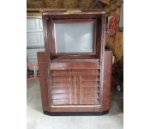
Put it back together and spent 3 hours watching it this morning, so it seems to be working for good, for now. Two things it still needs are a speaker (I have one hanging by one screw in there but I don't have one that's the right size to fit properly), and the ever-missing back. Usually, I only find table sets missing their backs, but these Admirals seem to be an exception. Here's a pic of it sitting next to some other sets.
As far as I understand the retrace blanking, you need the pluses doing the blanking pointing positive to connect to the CRT cathode, or negative to go to the g1. The other way and you wind up actually amplifying the retrace lines rather than cutting of the CRT during retrace. Also the lower the capacitance of the capacitor, the narrower the pulse. And you need the capacitor to keep the dc out, so you're only affecting the CRT when those pulses appear during the retrace. I read this article about it over on the etf website: http://www.earlytelevision.org/vertical_blaniking.html Everything else I've done was just by trial and error. I also added retrace blanking to this Airline, making the connection to the CRT g1: http://www.videokarma.org/showpost.p...2&postcount=15 But with this electrostatic set it was easy, because the signal going to one vertical deflection plate was the upsidedown version of the other, so you can have it either way. Last edited by Adam; 05-11-2014 at 07:42 PM.
|
| Audiokarma |
|
#21
06-26-2012, 08:24 PM
|
||||
|
||||
|
I finally scored a back for this set. As far as these Admirals go, I think the backs are rarer than the sets. But I need to replace a tube socket before I put it on (one of the video IFs). Every time I want to watch this set, I have to go back there and shake that tube (and it's not the tube - I tried several).
This leaves me with just 2 Motorola VT71's, a Hoffman 610, and an RCA 8T244 without backs. Last edited by Adam; 05-11-2014 at 07:47 PM.
|
|
#22
06-27-2012, 05:30 PM
|
||||
|
||||
|
Hey Adam, did you notice the tv like your avatar on ebay?
SR
|
|
#23
06-27-2012, 08:17 PM
|
||||
|
||||
|
Quote:
After you ran into this last year, mbear2K posted the Admiral factory modification to eliminate the retrace as published in Rider Production Change books. The booklets are both his site and on the ETF website: http://oldtubes.net/library/free_man...ures_Vol_1.pdf http://www.earlytelevision.org/tv_sc..._diagrams.html James.
|
|
#24
06-28-2012, 12:09 AM
|
||||
|
||||
|
Congrats on finding a back. I plan on pulling my 20B1 chassis and making the retrace mod mentioned above. I've used it on some 20X1 chassis and it worked very well

|
 |
|
|





 Linear Mode

