
|
|
|
#46
 04-07-2014, 11:45 PM
|
|||
|
|||
|
Sounds like a scary prospect. I find the inside of my Pioneer SX-82 to be scary enough. Aye, the things we actually used to plug in. :p
Personally, I'd rather have the GR 295, sold in the 67 - ? catalogs. Or the later GR-2000, which I always though sounded impressive. I made a (now corrected) mistake. I clipped that from the 1967 catalog, not the 1958. I don't even think Heath had a set in 58, but I've not looked at the catalogs lately. 
|
|
#47
04-08-2014, 01:53 PM
|
|||
|
|||
|
Latest news: Over this past weekend I took advantage of unusually warm weather here in CA and decided to go for it: i.e., to perform the de-cat operation! It turned out to be faster and easier than I had expected. The tube had been soaked for about 3 weeks and the access to insert the wedges (door jam shims and paint stirrers) was very easy. The tube was positioned in a padded galvanized steel, 14 gallon garbage can face up and the wedges inserted. I kept a kitchen timer going and every 1/2 hr. tapped the wedges where need to keep them just tight. About 1 hour in, I went to make another tap, but the safety glass had already popped and was free to remove. The temperature at the face of the tube was close to 120 degrees as measured with a common thermometer. The PVA layer was easy to remove and any residue was removed with soap and water. GoofOff aided desolving any remaining small spots left of the PVA. The reassembly of the safety glass to the CRT faceplate was straight forward and all was completed in about 2 1/2 hours.
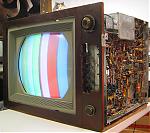
The following day I reinstalled the CRT in the chassis and fired it up. I had put marks on the neck of the tube for the placement of the yoke, convergence assembly, etc., which made it very easy to get back to a starter picture. I did a quick purity and convergence, etc., and the pictures below show you what the results are as of this moment. I'll give it another convergence once-over after the set is in its cabinet. I think it coming back very well for a set that's 60 years old!
|
|
#48
04-08-2014, 02:04 PM
|
|||
|
|||
|
wow that looks great!!
on the removal process as the glass starts to let go it accelerates and the contract point will shrink rater quickly until its about the size of a quarter, then it will "pop" and the lens will literally pop up. Nice job 
|
|
#50
04-08-2014, 04:17 PM
|
||||
|
||||
|
Holy Moses, that looks great!
|
| Audiokarma |
|
#51
04-09-2014, 02:09 PM
|
|||
|
|||
|
Ok, this is my last (?) message re the Heathkit GR-53A, it's also a reply to Kevin Kuehn who wanted to see the set in its cabinet.... Well here are two photos of the set in its cabinet with and without doors open. Where did that cabinet come from, Kevin? A plugged nickel to the first person to get it right.
|
|
#52
04-09-2014, 02:24 PM
|
||||
|
||||
|
Great Tuner Driven Shots
Ralph...........Mighty fine group of big screen shots. Was the sourse over the air, or video recorder thru the tuner/IF? I think that Heathkit deserves a video monitor mode like my 21CT55. Should be fairly easy, just inject video directly into the 1st video tube grid.....Tom
|
|
#53
04-09-2014, 03:34 PM
|
||||
|
||||
|
Quote:
-Steve D.
__________________
Please visit my CT-100, CTC-5, vintage color tv site: http://www.wtv-zone.com/Stevetek/
|
|
#54
04-09-2014, 03:47 PM
|
|||
|
|||
|
Tom, shooting comp video into this set is a bit harder than you might think given that the sound and sync have a separate detector from video and chroma which are also split ahead of the first luma video stage. Take a look at the attached portion of the schematic and you'll see what I mean. Also, pay attention to the fact that both negative and positive sync are sent to the vertical integrator and horizontal osc.
|
|
#55
04-09-2014, 04:52 PM
|
||||
|
||||
|
Wow, that cabinet almost makes it look like a European set.
__________________
Tom C. Zenith: The quality stays in EVEN after the name falls off! What I want. --> http://www.videokarma.org/showpost.p...62&postcount=4
|
| Audiokarma |
|
#56
04-09-2014, 06:25 PM
|
||||
|
||||
|
Another silly scheme
Ah-Da.........The lastest roundy I seriously investigated was my Dad's CT4 in the late '50's. I was completely unaware of the evolution of tube color tv into the early '60's which your Heathkit seems to be. I agree with you, it ain't worth the effort. But you could go direct video into the video cathode follower, video delay line and presumably chroma demodutor and CRT drivers. You would leave the sound and sync circuitry driven off the tuner/IF as original, just a thought? By the way, what RCA is it a clone of?.........Tom
|
|
#58
04-10-2014, 03:49 PM
|
|||
|
|||
|
Alright, enough time has passed for guesses re the make of the cabinet. No, it's not from Heathkit, Stromberg, Hallicrafters or whatnot; it's from CBS and originally had a 19 inch picture tube and 2 chassis' of guts to make it work! This was CBS's answer to RCA's CT-100 with (at the time) a radically different method of producing the color CRT compared to the 15GP22's silkscreen method. The original owner ditched the guts of the CBS and put in the Heathkit. Many years later he very much wished he had kept the set as was given its extreme rarity today. For more information, check out ETF's website under early color sets and look for a CBS 205 for a good discussion and schematic.
Incidentally, Steve Dichter won the contest and will be awarded the plugged nickel when next I see him. Congratulations, Steve!
|
 |
|
|








 Linear Mode

