
|
|
|
#1
 07-07-2024, 03:23 PM
|
|||
|
|||
|
Trav-Ler 321-48O console with UHF
For those interested, here's a thread finally about the TV I acquired recently. A friend of mine runs an antique/salvage shop in town and was contacted by someone in nearby Archer Lodge who had this in their barn. He got it for lunch money, and I was able to get it inexpensively as well. Pretty cool for something like this to turn up so close by. Radios and record players, even consoles, are easy enough to find at antique stores and shows, on craigslist, etc., but televisions seem few and far between in my experience.
I believe this set was built in 1954. There are crude "54" stamps in vermilion ink to be found on parts of the chassis and tubes; per reading up on the relevant plant/date codes, the Trav-Ler-branded 21YP4A picture tube was made by G.E. and date-coded for September 1954; and a couple of other Trav-Ler tubes are marked "9/54". Another G.E.-made Trav-Ler tube that I can see is date-coded July 1954. There are several replacement tubes of various makes, including a Japanese-made tube. This set is factory-equipped for UHF reception, having a 46A4 [edit: actually 49A4, see below] chassis and TV-TA-14 tuner. The tuner knob has a UHF position at one end of the handle, and a prism in said end through which one could read a pilot-lamp-illuminated plastic dial marked with UHF "decade" numbers (and a couple lines preceding the 20 that may indicate the minimum extent of adjustment) located behind the fine-tuning knob. The dial rotates the opposite direction of the fine-tuning knob, and seems stop-and-go so I suspect there's a cord or linkage of some sort to clean and lube. Interestingly, neither the Sams Photofact (set 240, folder 10) nor Rider service info (in Rider Television Manual vol. 13) cover the UHF features or this specific chassis, beyond Rider's listing it like an afterthought as covered by the info for the VHF-only 46A3 (apparently otherwise almost identical). Per the Rider info, the "O" suffix in the model number indicates it has anti-glare filtered safety glass versus the plain glass a 321-48 would have. Confusingly, although it specifically describes the "letter 'O'" as denoting this feature, and the model number is seemingly marked accordingly on my set, the Rider info lists the model number as "321-480" with a zero, and likewise for other models with this feature; the same with the Sams index, too. I found the factory schematic for the TV-TA-11 VHF/UHF tuner and 48A3/48A4 chassis in Beitman's 1955 volume TV-9 online, hopefully similar, but if someone has a lead on a schematic for the TV-TA-14 tuner or other servicing information specific to my set's UHF features, that would be nice. If anyone has an original brochure or advertising covering this particular set, I'd love to see that as well. Also, if anyone needs any of the service info included in the Photofact set or Rider manual I purchased, I'd be willing to photograph it, or maybe scan it, and share. The cable for one of the disconnected internal antennas continues past the spade tips and is terminated with a small board that I suppose connected somewhere inside the set; does anyone know what this was for? Condition-wise, it doesn't look bad for a literal barn find. The biggest issue I see is that the plastic deflection yoke cap and perhaps the sleeve have disintegrated beyond usability. I'm aware of Bob Andersen's Flickr album and YouTube videos (1, 2) on crafting replacement plastic covers using polystyrene sheets, which I'm leaning toward doing, but if others have different preferred approaches to replacing disintegrated covers, I would still welcome info on them. I gather this is a pretty common problem with 1950s yokes. I don't know if anyone 3D-prints reproductions of these covers, but it seems like it'd be an obvious application for that technology. The flyback coating has cracked, but my understanding (correct me if I'm wrong) is that this isn't necessarily a problem. The original 10", 4 ohm speaker had been purloined at some point, but whoever did so at least put the two mounting screws back in. I snagged a couple of compatible speakers on eBay, including a Zenith C49CZ649 that, I gather, was used in some of their late-'40s/early-'50s "porthole" consoles, and which I installed. It has the right type of connectors, a nice big magnet, and would probably sound better than the original Trav-Ler speaker. That said, if anyone happens to have a spare Trav-Ler TV-SPK-26, I'd be interested in it. I'm currently hoping to come up with a suitable donor piece of red mahogany veneer from old peeling furniture or something that I can cut to fit to replace a chip in the top veneer, caused and lost in a moment of sloppiness when I was unloading the TV. The Tenite knobs had a good amount of "white mold" (which may actually be butyric acid deposits leached from the plastic—or both), much of which rubbed off with damp paper towels while some needed a bit more than that. Alas, in certain spots on the volume knob primarily, the original luster was lost during my experimentation with cleaning agents telephone and radio collectors had suggested online for this affliction, but live and learn (I tried mineral spirits, ammonia, and finally LA's Totally Awesome which seemed the most gentle). I was more judicious with the tuner knob. It's tough to know which recommendations to follow when many collectors would be following the cleaning with polishing anyway, something I don't do, and tougher when people typically soak the plastic to remove the crust, while I didn't want to damage the paint or metal components and was thus cleaning them by hand with swabs and towels. I'm fairly content with how they are now for the most part and can tolerate a little leftover crust. I don't have a CRT tester, but the filament has continuity and the metal piece surrounding it only looks faintly yellowed, not the "blued" appearance I understand a worn-out tube would likely exhibit, so I'm hoping it's okay. If it's bad, I'll be in the market for another 21YP4A or possibly a compatible substitute. I'm not going to give up on this one due to a bad CRT. My current plan is to replace the electrolytic and paper capacitors (there don't seem to be all that many of the latter in this set, compared to the ceramic and mica ones), inspect and replace any dead tubes, and go from there if there are further problems. I don't have a bunch of test equipment, just a multimeter right now, though I plan to at least have an isolation transformer and dim-bulb tester, and maybe acquire some other equipment eventually as I can afford it since it tends to be expensive (on eBay at least). I'm not rushing into this and am planning to do a radio or two first to get the hang of the basics before proceeding with recapping the TV. 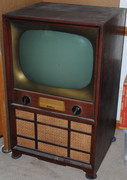 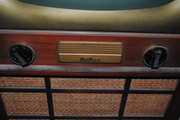 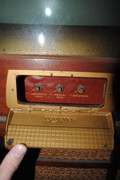 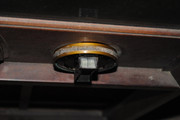 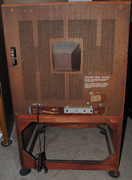 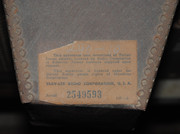 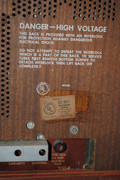 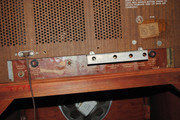 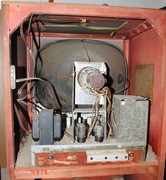 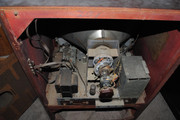 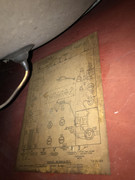 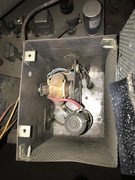
Last edited by Walnut2; 07-13-2024 at 01:08 PM. 
|
|
|


 Threaded Mode