
|
|
|
|
|
#1
 01-01-2008, 07:42 AM
|
||||
|
||||
|
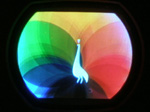
Here is another try of correct color vs. Y relation with the 21AXP22A of the CTC5. Note that the green does not look enough greenish like it is displayed on the screen. This is a true camera artifact.
- Eckhard 
|
|
#2
01-01-2008, 08:46 AM
|
||||
|
||||
|
Quote:
|
|
#3
01-01-2008, 10:28 AM
|
||||
|
||||
|
Hi Pete,
take this file http://bs.cyty.com/menschen/e-etzold...mg/rainbow.JPG burn it on a CD, and play it with a DVD-player. What would it look on your CT-100? The white is 100%. Contrast and brightness at maximum with a bright white and a dark black, just before blooming, and then add color. - Eckhard
|
|
#4
01-01-2008, 12:43 PM
|
||||
|
||||
|
Quote:
Not sure what the exercise will demonstrate. But there are two things it would look like that depend on the hardware involved; indulge me and check me to see that we're on the same page: [1] Take a 'perfect' or reference color bar (as you have provided) and reproduce it on an sRGB TV or monitor driven via component or DVI or HDMI, and you get a 'perfect' (okay, really, really good) color bar image. I've done that and photographed the sRGB-phosphors screen with an sRGB digital camera and generated an sRGB color space jpg. It can be seen here. link. [2] That same reference color bar signal turned into an NTSC signal by a DVD player [and either modulated or directly introduced into the first video amplifier (which is the way I do it)] is going to be corrupted or at least constrained by the NTSC system and the DVD-player version of NTSC. I think I would see what I see now since the color bar pattern on my DVD is essentially reference quality before it takes the long NTSC route to my 15GP22 screen, and as I have noted above, the brightness/contrast range is already adjusted correctly as shown on a screen shot earlier. There is another factor not yet mentioned -- that of high-voltage. Your CTC5 has what, 25 kV to play with and the regulator is far better than the 6BD4 circuit used in the CT-100. (Even, by comparison, the Westinghouse H850CK15 has, by observation, a far more stable high-voltage supply.) Not an excuse, but blooming by the Bloomington set is a salient factor in the available brightness/contrast range issue. Pete
|
|
#5
01-01-2008, 01:11 PM
|
||||
|
||||
|
Hi Pete,
Quote:
Quote:
Quote:
Quote:
I believe that your CT-100 has a much better color performance than it is shown here in your demonstrations, and this is what I want to prove with these tests. When I got the CTC5, I misadjusted color and brightness a lot of times before I understood how it works. I did only know the PAL tv sets, and they are working different. - Eckhard Last edited by yagosaga; 01-01-2008 at 01:13 PM. Reason: added photo
|
| Audiokarma |
|
#6
01-01-2008, 02:33 PM
|
||||
|
||||
|
100% amplitude bars are NOT good for playing through a RF modulator. The NTSC system (and PAL) are designed to overmodulate the yellow and cyan bars in this case, since such full amplitude colors are almost never encountered in natural scenes.
The 75% bars are not 75% saturated, they are 100% saturated, but 75% amplitude. However, they are usually set next to a 100% white bar, which makes all of them look darker by comparison. When this pattern is used, it happens that the yellow bar chroma peaks equal the amplitude of the 100% white bar, so it is safe from overmodulation. The picture posted by Pete is actually quite good, just the white balance and exposure of the still camera is off. I have attached an adjusted copy, which should be much closer to the visual effect in person.
|
|
#7
01-01-2008, 03:23 PM
|
||||
|
||||
|
Quote:
Quote:
Here is a link to color bars on a 15GP22 which looks similar to your adjusted copy: http://bs.cyty.com/menschen/e-etzold...5inBetrieb.jpg - Eckhard
|
 |
| Thread Tools | |
| Display Modes | |
|
|






 Hybrid Mode
