
|
|
|
|
|
#1
 12-29-2022, 03:01 PM
|
||||
|
||||
|
Thanks for the wealth of information. I was earlier pondering why the focus and HV supplies were drooping on video high average luma level scenes. I suppose it was driving the tube to hard. Everything settles down if you back off the contrast.
The set otherwise appears healthy apart from one odd anomaly: when powering up, after about 40 seconds the sounds comes up and you hear the characteristic HV crackle. The picture is initially low contrast. About after two minutes the contrast comes up. It is as if one tube in the video chain is extra slow warming. When testing the tubes, the emission was good and I have replaced many (most) of the tubes. Any thoughts? Last edited by Penthode; 12-29-2022 at 08:15 PM. 
|
|
#2
12-29-2022, 05:06 PM
|
||||
|
||||
|
You could do the 7 second test, pull one tube in the video chain while it's warmed up, plug it back in 7 seconds later and see if contrast returns fast or slow and repeat till you find your culprit or through all possible tubes that could cause it.
I have to commend you for actually listing the parts you used for the peaking coils...Other brilliant minds here have gone through the same effort without listing part numbers, and only giving a vague notion of the brand and the process with their specific test equipment, so someone without the right gear can't duicate their results. It's good to teach the process, but it's also important to explain the results of the process so others can check the work, and benefit from it.
__________________
Tom C. Zenith: The quality stays in EVEN after the name falls off! What I want. --> http://www.videokarma.org/showpost.p...62&postcount=4 Last edited by Electronic M; 12-29-2022 at 05:09 PM.
|
|
#3
12-30-2022, 12:46 AM
|
||||
|
||||
|
Quote:
I will put the scope to the circuit tomorrow.
|
|
#4
12-31-2022, 08:38 PM
|
||||
|
||||
|
Spent much of yesterday determined to solve the AGC problem. AGC was wonky:picture would appear about a minute late and if you advanced the AGC control and returned it, you would enter picture overload and it would not recover unless you detuned.
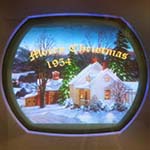
Checked the waveforms (courtesy of the Sams notes) fror AGC keyer in and keyer plate and was correct. I had changed the paper capacitors and checking resistors, the 4.7 Mohm resistor (used for agc delay) was open. After replacing the resistor, the AGC system slowly oscillated between overload and positive video. As it is a closed loop system, tried checking tubes. After about four hours, it occurred to me to check the AGC line for wiring. Recall the IF section was badly rusted due the mouse inhabitants. I finally discovered a little choke feeding AGC voltage to the 2nd IF stage open! It was affected by the mouse urine and had earlier tested okay after I cleaned it and reinstalled it. The corroded leads broke of as I removed it a second time. So I performed an autopy on it and in the process found it was simply a winding of a single layer of AWG 44 wire. I took a 1 Mohm 1/2w resistor and made replacement holding the resistor in a variable speed Ryobi power drill. Installed the choke and AGC worked properly and as it should. There was a happy side benefit to all this: I checked again the IF response due to the added choke. Went through the full sweep alignment in an hour as outlined in the RCA instructions. Recall from my earlier postI had to make addition tweaks to stages to minimize a bump in the response around the video carrier? Wekl that annoying bump disappeared after the choke fix. The RCA instructions said you only need to slightly tweak T109, T110 and T111 (third fourth and fifth IF stage bifilar transformers) to get the proper response. Sure enough, the final oberall sweep was very close and as RCA prescribed, only those three transformers needed minor tweaks to get a good response! I have included pictures of the chokes and the set as it is now performing. Last edited by Penthode; 01-01-2023 at 07:51 AM.
|
|
#6
01-01-2023, 08:13 AM
|
|||
|
|||
|
Quote:
|
|
#7
12-29-2022, 06:02 PM
|
|||
|
|||
|
I guess that these sets were used in a rather dim room and that was normal. When I worked for E.J. Korvette, (1966-1967) color sets were in a special room and the light was dim. I have a CTC-9 in queue and I must remember this when I finish restoring it. I do have a raster so far!
|
|
#8
01-01-2023, 12:33 PM
|
||||
|
||||
|
Great detective work!
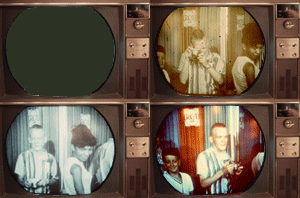
Those pics look super! White balance and purity look about perfect. Can you capture some pics from an old favorite source like The Wizard of Oz?
|
|
#10
01-03-2023, 11:40 PM
|
||||
|
||||
|
Spent a bit of time on the set tonight. It is working well. Issues are fairly minor. Here is a rundown of the good vs bad points.
The Good: 1. Repeated the full IF sweep alignment. This was to ensure each preliminary stage of the IF alignment fell into place so that the final overall sweep alignment only required minor adjustments. Succeeded with only having to make minor tweaks to get the proper response. With the entire RF - IF alignment, chroma bandpass and demodulators complete and successful peaking coil replacements for the luma, I and Q channels, the picture is nice and sharp with no ringing. 2. Convergence very good. Better than I had expected with the electrostatic convergence. The Bad: 1. Cannot get as good purity as I think it should. Could not get rid of a green contamination in the lower right raster. I removed the chassis to demagnetized as best I could with a degaussing coil to no avail. Was able to conceal it with compromises. 2. AGC problem. Although I fixed the open choke, the AGC still provides "bi-stable" operation. Set starts up okay. However, if you interrupt the signal briefly and reapply, the the AGC voltage drops to zero and the video overloads. By detuning with the fine tuning control and retuning the picture returns. The problem disappears if I remove the AGC delay 4.7Mohm resistor (between AGC line and B plus). Checked all components and wiring. (Recall I had to disassemble the IF chassis to remove the heavy rusting). 3. 15GP22 socket intermittent. The red dropped out this evening. Checked okay the voltages for the red gun at the tube socket. Flexed slightly the socket and the red returned. Suspect it is the Red Screen pin 4 connection which is iffy. I earlier cleaned a rebuilt the CRT socket on the set. The 20 pin plug on the tube it looks like a large chunk of the socket previously broke away and the previous set minder reconstructed it with an epoxy resin. Appears they used a mould for the resin and was well done. However it would be nice to put a good original socket on it. Does anyone know if there are any available? I hooked up the DVD player and played the prerequisite Wizard of Oz... Last edited by Penthode; 01-04-2023 at 09:17 AM.
|
| Audiokarma |
|
#11
01-04-2023, 12:41 PM
|
||||
|
||||
|
Quote: Spent a bit of time on the set tonight. It is working well. Issues are fairly minor. Here is a rundown of the good vs bad points.
comments interspersed: The Good: 1. 2. Convergence very good. Better than I had expected with the electrostatic convergence. IF you adjust adjustments 82-88 (of 88!) carefully you can get almost perfect convergence. These are the tilts and translations of the yoke. The Bad: 1. Cannot get as good purity as I think it should. My first CRT, now gassy, had great convergence. My current one has a bit of red in two places that I just can't get rid of. Its really very minor, even on a B&W picture. 2. AGC problem. I had the exact same thing. Simple cure: since you are running on a local modulator, signal is too strong. Install a pad right at the set terminals. I have a cheapie balun followed by a balanced 300 ohm pi-pad made from 1/2 watt resistors. That instantly cured this infuriating problem. Signal to noise is still essentially perfect. I recall that my uncle, in 1954, had the exact same problem ... he lived 3/4 mile from the tower! But it was already known, since his huge B&W set had the same pad necessary. So does my Hallicrafter's 7 inch set. Other sets work fine with the huge signal. 3. 15GP22 socket intermittent. I had the same problem on a filament terminal. I got a replacement socket from the ETF but did not use it ... I just carefully bent the contact a tiny bit in the original socket. The replacement would work, but its not the same constrution and would need some machine shop work to be reliable. I hooked up the DVD player and played the prerequisite Wizard of Oz...
|
|
#12
01-06-2023, 12:01 AM
|
||||
|
||||
|
Quote:
Removing the 4.7 Mohm AGC delay resistor alleviates the problem at the expense of lowered S/N. (As if that is a problem nowadays). Perhaps lifting the 0.1 ufd would fix this? I am not going to bother since simply attenuating the signal was the fix. Very appreciative of this tidbit of information. And than to both of you for the 15GP22 socket tip. Last edited by Penthode; 01-06-2023 at 08:16 AM.
|
|
#13
01-04-2023, 10:25 AM
|
||||
|
||||
|
Coming along nicely!
|
|
#14
01-04-2023, 01:33 PM
|
||||
|
||||
|
Very nice images! My opinion only, looks to lack a bit of contrast, can you adjust? I know this is subjective.
Try contacting Steve McVoy at the Early Television Foundation. I received one for my 15GP22. EDIT: I’m sure the images are much better than the camera captured.
__________________

Last edited by etype2; 01-04-2023 at 03:51 PM.
|
|
#15
01-04-2023, 05:24 PM
|
||||
|
||||
|
Quote:
I think black level ("Brightness" control) is a tad high in these photos - an easy adjustment. Things like this can happen if you adjust the set with room lights on and then turn them off to take pics or vice versa. If the brightness control is at minimum, it would indicate that CRT bias voltages need some adjustment. Also want to suggest taking the time to get the camera lined up dead center to avoid perspective distortion.
|
| Audiokarma |
 |
| Thread Tools | |
| Display Modes | |
|
|









 Hybrid Mode
