
|
|
|
|
|
#1
 12-24-2025, 02:43 PM
|
||||
|
||||
|
It should work fine with a modern 525 signal source. Otherwise, there are standards converter kits for 441 line.

|
|
#3
12-24-2025, 06:48 PM
|
||||
|
||||
|
I believe the 441 line upgrade did realign the IF for 4.5MHz audio carrier spacing and VSB. The sound detector is AM but will handle FM to some extent. Quality and volume won't be great but we should hear something,
|
|
#4
12-24-2025, 09:18 PM
|
||||
|
||||
|
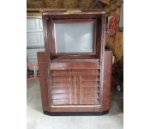
With sets selling as fast as the plants could crank them out in '49, if this one was available for free to someone, I could see someone dumping a bunch of time into it...with hopes of having television for "nothing". It's hard to imagine it impressed anyone with those hacks but, heck, people were buying 3" Pilots. I could see guys like us giving it a try if we were around back then.
Making it look right will prove, I feel, quite a bit more of a challenge than making it work. But 100%, it will happen.
__________________
Bryan
|
|
#5
12-24-2025, 10:49 PM
|
||||
|
||||
|
From July 1936, the RCA television field trial was tested on the FCC authorized experimental frequency band: 44 to 50MHz. In 1938, the FCC authorized the band 39MHz to 44MHz for Armstrongs FM experiments.
From July 1936, RCA television utilized on the 44 to 50 MHz band a video carrier frequency of 46.5 MHz and an aural (sound) carrier frequency of 49.75 MHz. This meant the video audio carrier spacing was 3.25 MHz and the video bandwidth for 343 line interlaced at 60 fields per second was 2.5MHz. Video Modulation: Amplitude Modulation (AM), double sideband. Audio Modulation: Amplitude Modulation (AM), double sideband. 343 line television used thru 1936-1937 was pre Kell Factor. The introduction of the Kell Factor in late 1937 early 1938 allowed for the increase of lines to 441. Video transmission was still AM double sideband with the same 3.25MHz video-aural carrier spacing. In April 1939, about a couple of weeks prior to the the television demonstration, RCA switched to VSB with the video- aural sound spacing I believe at 4.5MHz at that point. There must have been a jump in horizontal resolution which was maintained until 1941 with the NTSC adoption of 525 line and reduced relative horizontal resolution with the 0.6 Kell Factor. Note that the UK 1934 BBC 405 line standard was designed with pre Kell Factor of unity. I recall reading of CBS engineers visiting the UK in the 1950s viewing BBC 405 pictures and remarking how sharp the images were. (Although that may have been mostly due to the 4.5" image orthicon tubes the British were using at the time). So the move to VSB was not until April 1939 which means the 1937 set most certainly would have had a 3.25MHz sound spacing and only a 2.5 MHz video bandwidth. If a 525 video was to be applied, the pictures will be quite soft unless the amplifier design is modified. Also because the IF band in this set was from around 8 to 14 MHz, altering the response to achieve a good vestigial sideband response with accurately place Nyquist slope could be a bit of a challenge. Lastly the horizontal sweep frequency of 343line was 10,290Hz. (Not far from the 405line horizontal sweep rate of 10,125Hz). Moving it to 15,750Hz and ensuring efficiency and linearity may be (or once was) a challenge. My guess is some of the changes were done likely professionally initially by the factory and later hacked for NTSC 525 and FM sound with the hacked new tuner. I expect you will discover interesting attempts to more or less enable the set to cope with the later NTSC signal. But it would be interesting to see it perform as originally intended on 343 or 441 lines. The information on the 1930s RCA television development is well preserved in the RCA publication of Television in five volumes. I have attached a link to Volume 1 covering 1933-1936. https://archive.org/details/televisionvoli1901unse Last edited by Penthode; 12-24-2025 at 11:10 PM.
|
| Audiokarma |
|
#6
12-25-2025, 08:35 AM
|
||||
|
||||
|
A few corrections:
Their 343 line standard was 2.25MHz. From the "TEST INSTRUCTIONS FOR THE R.F. ALIGNMENT OF THE RC-199 TELEVISION RECEIVER" document attached. The resolution was 1.5MHz not 2.5MHz as listed and graphed in the "HIGH DEFINITION TELEVISION RECEIVER NINE INCH MIRROR LID CONSOLE TYPE RR-359" manual. A copy of my manual can be found here: https://www.earlytelevision.org/pdf/...359_manual.pdf Dr Kell devised the "Kell Factor" in 1934 well before the design of these sets so it was in use when these sets were designed. The RR-359A's have a Kell Factor of about 0.6. The vid/aud spacing was changed to 4.5MHz in 1937 when the sets were upgraded to the 12" RR-359B's. All the video IF's and mixer were swapped out for the "B" upgrade per the "CHANGE FOR CONVERTING RC-199 TO RC-199B" engineering document. This doc also outlines various component value changes throughout the chassis. No changes to the horizontal sweep needed to be made. They run efficiently from 240 to 625 lines with full width and good linearity. All pre-war television run fairly well on FM audio using slope detection. RCA put out a letter to all registered owners after the change in 1941 that they would align their sets for slope detection at no cost. Last edited by tubesrule; 12-25-2025 at 08:29 PM.
|
|
#7
12-25-2025, 06:49 PM
|
||||
|
||||
|
2.25 MHz sound spacing was used in 1933-34 not for the 1936 343 line and 441 line broadcast tests from July 1936. It is described in the volume 1
Television. Do not confuse this with the earlier 240 tests described. Goldsmith described that RCA engineers arrived at a 6MHz channel without the details of the video-aural carrier frequency spacing. You have to dig a bit to find the information. But think logically about this: they identify the carrier frequencies which would fit nicely in the 44MHz to 50MHz channel. The RCA Volume 1 Television explicitly lists the sound carrier as 49.75MHz and the video carrier at 46.5MHz. The difference.is 3.25MHz. The video aural carrier spacing could not be moved to 4.5MHz until after the modification from double sideband to vestigial sideband which RCA made immediately before the 1939 World's Fair. Your documentation identifying the change must be from 1939 not 1937.. I know this is correct. I encourage you to look for it. If you require further evidence I will dig it out for you. Last edited by Penthode; 12-25-2025 at 06:53 PM.
|
|
#8
12-25-2025, 07:35 PM
|
||||
|
||||
|
Find attached pg 17 from volume 2 of Television, "Recent Developments in Television". Note how the 343line 3.25MHz video aural carrier spacing was also used for 441 lines.
Next I will look for evidence of the 4.5MHz video aural carrier spacing switch. 4.5MHz spacing could not be used for the AM double sideband transmissions prior to April 1939.
|
|
#9
12-25-2025, 07:50 PM
|
||||
|
||||
|
What I've stated was not guesses or extrapolations. I am very familiar with all of RCA's television development from 1928 thru the TRK sets as I have most of the original manuals, engineer notebooks, schematics, photographs, etc., part of which I have shared with Bob. I have quoted from my original RR-359 service manual and RF alignment engineering supplement and the RR-359B engineering change log. I have provided Bob with the schematics and photographs of his set. All these documents came from the original RCA engineers, DeHaven, Holmes, Carlson, etc.
I am familiar with the specifications, performance and operation of my own RR-359A1 and RR-359B and other prototype sets. I enjoy looking through the Television series books, but there are many deliberate misdirections, like the LO being coupled through the tuning capacitor shaft on the continuous 359 tuner. I'll stick with the original engineering documents and the actual sets  Darryl
|
|
#10
12-25-2025, 08:22 PM
|
||||
|
||||
|
If only Holmes and Lev had read the Television books before writing the RF Alignment engineering note for the RC-199 (RR-359A main chassis) dated June 22, 1936
 The RC-199 (RR-359A) was 2.25Mhz spacing, the initial change to RC-199B (RR-359B) was 3.25MHz, the final modifications to RC-199B was 4.5MHz. Last edited by tubesrule; 12-25-2025 at 08:27 PM.
|
| Audiokarma |
|
#11
12-26-2025, 12:14 AM
|
||||
|
||||
|
The notes if dated June 22, 1936 is curious. Clearly the 240 line system had a narrower channel. The frequency response depicted in the second attachment does not relate to the July 1936 test and mail perhaps be a 240 line channel video aural carrier spacing which was approximately 1.5MHz. the 2.25MHz appears perhaps simply to define a reference between the sound carrier position and edge of the video response not the carrier position. Remember this is pre VSB transmission.
It appears development was moving rapidly and the decision to raise the resolution with number of lines which required wider bandwidth may have occurred rapidly. This can be gathered from the volume 1 Television. Last edited by Penthode; 12-26-2025 at 07:58 AM.
|
|
#12
12-26-2025, 10:45 AM
|
||||
|
||||
|
The discussion of the 1930's American transmission channel has raised a few questions in my mind pertaining to television receiver design. It may be interesting to compare RCA's development with it's sister Marconi/EMI partner.
The development of the 405 line standard is interesting. It was early and a somewhat premature standard which persisted for nearly five decades. Positive modulation, no equalizing pulses and video delivered AM full double sideband on the original Alexandra Palace transmission channel 1 until 1956. Subequent VHF channels added with the post WWII UK expansion on channel 2 upwards was vestigial sideband. I restored a Baird T5 (1936), an HMV 900 (1937) and a Baird T-18 (1938) and each did not have a tuner. I recall the T5 and 900 used superheterodyne frequency conversion in the video channel. Th Baird T-18 was a straight TRF video receiver with the video rf amplifier tuned to channel 1. (UK prewar receivers were later provided with heterodyne converter adaptors so the prewar sets could receiver other than channel 1. I also previously restored post war HMV, Bush and Pye receivers. These video receivers were designed for vestigial sideband reception of all the postwar channels. It is important to note that a vestigial sideband designed receiver can properly demodulate double sideband signals without distortion but the opposite is not true. So prewar receivers had to have the video IF response modified to provide a nyquist slope for proper demodulation. This leads me to the American development of receivers in the late 30's. It must have been noticed early on when designing sets in the effort to reduce the tube count and save money by narrowing the receiver amplifier bandwidth that when tuned to one side with the video carrier on the response sliope that the video baseband response would be extended. In other words the benefits of receiver design cost savings came first even before the consideration of RF spectrum savings. This leads me to wonder if the frequecy response depicted in figure 2 was an attempt of the earliest implementation of the nyquist slope detection prior to VSB transmission?
|
|
#13
12-27-2025, 04:45 PM
|
||||
|
||||
|
Quote:
|
|
#14
12-26-2025, 10:47 AM
|
||||
|
||||
|
The Television series of books can be a decent reference but the articles are taken mostly from RCA Review and are usually "after the fact" of the event as RCA was not one to publish current work in progress.
The RR-359A at the ETF hds been extensively modified after if left RCA and can't be used as a reference for the initial state of these sets. My RR-359A1 and the other RR-359A in a private collection are both 2.25MHz carrier spacing. Television II does mention this. These sets went through a whirlwind of changes and while I have much of the documentation, there are many things unknown as to when the change actually occurred. For examples: The sets all original had continuous tuners, 7 controls under the lid and a metal crt shield. The 359B's are mixture of continuous/detent tuners, 7 vs 3 controls (the other 4 were rotated down under the deck board), and metal vs the cardboard sleeve later used on the TRK12 which also required a change to the deck board. While all these changes were made to the later B's, I have found no documentation as to when the change over for each occurred. One RR-359B was modified to be used as the Master Receiver at the 1939 Worlds Fair. Since the LO leakage was terrible from pre-war sets, they could not operate the rows of TRK-12's and RR359B's in the pavilion using RF. This RR-359B was modified with line outputs (a cathode follower for video and an extra audio amplifier) which then fed the display TRK-12's and RR-359B's modified with line input amplifiers. This set has the "regular" RR-359B IF's and the original schematic, while showing the line output modifications, does not show any IF changes. This set works properly on a VSB signal. (for some reason I can't upload files today, the above reference is in Television II page 35) Last edited by tubesrule; 12-27-2025 at 06:48 AM.
|
|
#15
12-26-2025, 04:38 PM
|
||||
|
||||
|
The channel spacing is not 2.25MHz. In 1936, the channels were 6MHz spaced.
The 3.25MHz carrier spacing was used from June 1936 thru 1939 when 4.5MHz carrier spacing was adopted. The figure 2 drawing you depicted is dubious and the information you provided was correct and misinterpreted because the 2.25MHz is referring to the video response not the carrier spacing. It is clear and documented. And from a purely engineering perspective ithe 3.25 MHz makes sense as it allows the double sideband video and sound carriers to fit into the 6 MHz channel with an appropriate guard band between audio and video. This is purely academic because as you said the sets have been extensively modified to work on the later standard.
|
| Audiokarma |
 |
| Thread Tools | |
| Display Modes | |
|
|







 Hybrid Mode
