
|
|
|
|
|
#1
 01-09-2012, 09:13 PM
|
||||
|
||||
|
I believe that my setting the Silvertone on the carpet (thus causing the bottom vents to be blocked) because I needed to remove the set it was sitting on to make room for the CTC4 was the reason it quit. I'll have to pull the back to find the scientiffic cause of the failure.
I can't compare the 21GUP side by side to the white face 21FBP until I get the CTC4 (which is using a white face 21FBP) working right, but I can give a qualitative, across-the-Midwest comparison of the 15GP (in the CT-100 at the ETF) and the 21GUP in my set.....The 15GP has deeper greens and better saturated colors overall than any other set I've seen in operation (except maybe Nicks 21-CT-55), but my 21GUP comes closer than any other CRT I own ( and have used in a properly adjusted set) to the stunning colorimetry of the 15GP.
__________________
Tom C. Zenith: The quality stays in EVEN after the name falls off! What I want. --> http://www.videokarma.org/showpost.p...62&postcount=4 
|
|
#2
01-12-2012, 12:49 PM
|
||||
|
||||
|
Wayne. I understand the original RCA CTC2 chassis was a true I-Y/Q-Y axis chroma 90 degree quadrature demodulator system to precisely recover the two chroma components in quadrature sent by the transmitter.. However the CTC2B chassis is a R-Y/Q-Y chroma non-90 degree axis quadrature demodulator system. Seems "The General" ordered RCA engineers to adopt this "buggered" quadrature demodulation system on the CTC2B to avoid paying a license fee to I believe Philco. The R-Y axis is 90 degrees from the reference burst and 33 degrees from the proper I-Y axis, any inherent R-Y demodulator component errors could be "mostly" removed by resistor changes in the chassis's low level matrix system. My Sept 11,2007 21CT55 reactivation project notebook indicates I considered the modification of the CTC2B's irrational R-Y/Q-Y matrix to the CTC2's proper I-Y/Q-Y configuration a no-brainer, accomplished with the addition of 2 resistors as shown in Oct 13,2007. This was the first of many "experimental" modifications I would make to this chassis. I had already exchanged the original 21AXP22 for the much brighter 21FBP22A rare earth in 1965 and made no suggested chassis changes to compensate for differences in CRT brightness. The picture quality of the present 21CT55 is quite acceptable but could possibly be better with a rigorous colometry alignment in the near future.....Tom
Last edited by Tomcomm; 01-12-2012 at 02:37 PM.
|
|
#3
01-12-2012, 02:27 PM
|
||||
|
||||
|
Quote:
|
|
#4
01-12-2012, 02:56 PM
|
||||
|
||||
|
That quote of mine had NOTHING to do with checking for black matrix. I was talking about operational colorimetry.
It is difficult to get a good look at the phosphor dots of the 21GUP with the safety glass on...So I was planning to pull the tube and remove the safety glass and look at it up close with it not running (my eyes are young, and considering I've seen a delta gun black matrix CRT up close before I should be able to tell if it is one by naked eye).
__________________
Tom C. Zenith: The quality stays in EVEN after the name falls off! What I want. --> http://www.videokarma.org/showpost.p...62&postcount=4
|
|
#5
01-12-2012, 08:08 PM
|
||||
|
||||
|
Tom C., sorry I misread that you intended not to look for the black matrix in the non-operating condition.
If a tube is black-matrix, it definitely will not have NTSC green. The chroma electrical matrix (or equivalently, the demodulator gains and angles) can provide some correction and can give very pleasing color, but cannot make the green phosphor less yellow or improve the cyan saturation to the same level as a 15GP22. Also, the corrections that fix the hue range between red and green always result in making the reds brighter and the cyans darker than a tube with NTSC phosphors, as a result of the tube gamma characteristic.
|
| Audiokarma |
|
#6
04-06-2012, 10:29 AM
|
||||
|
||||
|
21CT55 Screen-Shot Sampler
This is a 900X600 JPG composite containing 54 100x60 JPG 21CT55 screen-shots. No particular significance implied, since each was originally shot at 1024X768 JPG. Picture Quality screen capture has always been the main object of this RCA CTC2B monitor-only project. More full size screen shots will follow.

Last edited by Tomcomm; 10-26-2015 at 03:46 PM.
|
|
#8
04-07-2012, 02:12 AM
|
||||
|
||||
|
That is a great mosaic, Tom. I might show that to people, and watch them freak out when I tell them it is all from a 1954-55 color TV set.
__________________
Chris Quote from another forum: "(Antique TV collecting) always seemed to me to be a fringe hobby that only weirdos did."
|
|
#9
04-07-2012, 03:10 PM
|
||||
|
||||
|
21CT55 Screen-Shot Collection
Thanks Chris for the compliment. Full size pics of the 21CT55 screen-shots compared to a Sony Pro monitor is presented here:
http://www.flickr.com/photos/tomcomm/?saved=1 Dave, I hope your CTC5 fly is good. I have plenty of documentation of my CTC2B's fly conversion to a CTC20 fly, but it was a bitch to do! I wish you luck with your CTC5.....Tom
|
|
#10
04-07-2012, 04:48 PM
|
|||
|
|||
|
well I figure worst case I will just re do it with a FLY/convergence board from a CTC-15, and hope the various pick offs will not be too much, but hopefully at least one of the two flys will be ok.
|
| Audiokarma |
|
#11
04-10-2012, 08:28 PM
|
||||
|
||||
|
Wow, I had no idea that an early tv could develop such a good picture. I am a radio man and I have messed with b&w tv.
When it comes to color I am lost.... What does the I or Q stand for when you talking about wide bandwidth color tv?
|
|
#12
04-10-2012, 09:25 PM
|
||||
|
||||
|
Quote:
Quote:
http://www.antiqueradio.org/RCACT-10..._Your_Color_IQ
__________________
Evolution... 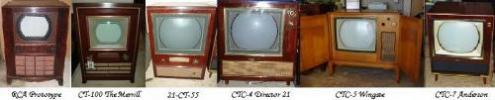
|
|
#13
04-10-2012, 09:56 PM
|
||||
|
||||
|
Wow ,I had to ask. Ok..... what about dc restoration? What is that? If I am right that was used for better contrast on the black and whites sets.Also does digital tv still process color the same way?
|
 |
| Thread Tools | |
| Display Modes | |
|
|








 Hybrid Mode
