
|
|
|
|
|
#1
 07-20-2009, 06:00 AM
|
||||
|
||||
|
The most important consideration (aside from the obvious ones such as compatibility with 70-degree color chassis of any kind in the first place) in using a test rig with a particular model of 70-degree color chassis similar to one which it supports directly is matching the impedances of the respective yoke windings in the rig to those of the set's own yoke within a reasonable tolerance. For both windings, +/-10% is preferred, while +/-15% is about the maximum tolerable degree of mismatch. Most 70-degree color yokes will typically have similar impedances, within +/-20%, as an educated guess. Uncontrollable vertical "rolling" seems to be the most frequently occurring symptom when operating test rigs with 70-degree color chassis when there is a moderate mismatch of convergence ballasts. Of course, a severe mismatch could easily damage the rig or the chassis, or both.
The importance of avoiding CRT "burn in" on the rig, but especially the prevention of damage to the picture tube in the set under test, cannot be overstated. Burn-in is damage which not even a CRT rebuild can correct. Just like a snapped neck, the only cure for a badly burned screen is a replacement tube. Both of my "daily use" 5AXP4 tubes for B/W bench testing, my "spare" 5AXP4 tube, and my 8XP4 and 8YP4 tubes all show signs of having been operated without deflection at least once before I acquired them. When using these tubes, I insert them into the yoke of the chassis under test or disconnect the set's own yoke and connect the extension cables of an appropriate B/W "substitution box" unit (basically, the B/W equivalents of the CK3000, using either a 5" round or 8" rectangular test CRT) to all of the appropriate connections on the chassis under test. The tubes in these units have pre-existing "dead spots" in the center of their screens from prior misuse, but are still capable of producing a picture adequate for troubleshooting purposes. Until I can locate undamaged examples of them (probably would have to be NOS, since ALL "used" tubes seem to have been MISused at least once), my existing tubes will just have to suffice. When performing grayscale setup of a color chassis, during which the Service switch will disable vertical sweep, it is very important to preset all three G2/Screen controls fully CCW and set CRT Bias and Brightness to completely extinguish the raster before placing the switch in the Service position. Failure to do this could permanently damage the set's own CRT in a matter of mere seconds. The MAXIMUM brightness of the Service line should be just barely visible in a dimly-lit room. Grayscale setup procedures outlined in textbooks on color TV servicing and/or service literature vary somewhat for different textbook publishers and/or set models. Some will specify that the Service line should be barely-visible, while others will state that the G2/Screen controls should first be set to the point where the line just appears and then backed off to the point at which the line is just extinguished. Last edited by jshorva65; 07-20-2009 at 06:14 AM. 
|
|
#2
07-20-2009, 11:55 AM
|
||||
|
||||
|
For bw I use a remote mounted test crt with its own yoke. The leads have self-penatrating alligator clips. One day I had it hooked up and the clips weren't in far enough. When it powered up I was greeted with a small dot in the center that actually glowed orange. So, now I have a black mark in the middle. Not an issue at all for me, but a warning not to do things like that again!
John, I have a NOS test crt upstairs that a friend asked me to sell. If interested let me know.
__________________
Bryan
|
|
#3
10-25-2009, 08:57 AM
|
||||
|
||||
|
Well, I finally got back in the old_tv business this weekend.
I checked out the convergence circuits by putting a current probe on the covergence coil wires, and I see all three are getting H convergence parabolas. However, I just can't get convergence, (R-G vertically and B horizontally). I tried playing with the positioning, since I can't see the pole pieces (covered by dag). I'm guessing now that I can't get the coils forward enough - the greatest action occurs when it is right up against the yoke, which has to be where it is for purity. (The yoke is almost all the way forward too, as you would expect after subbing the bell-shaped 21FB for the cone-shaped 21AX.) Not sure what to try next - maybe if I forget purity and see how far forward the yoke will go, I can try moving the convergence coils further forward just to see if convergence improves. By the way, the donor visited a few weeks ago, and was happy to finally see pictures on the set he remembers watching at home - so the work has some purpose so far, but I sure would like to get it right.
|
|
#4
12-13-2009, 04:20 PM
|
||||
|
||||
|
more convergence
Another long hiatus, then finally got back to the set today. Since I can't see where the pole pieces are in this rebuilt tube, I was thinking maybe the convergence coils need to be more forward. Turns out the opposite is true. After a lot of back and forth and turning the assembly to see what position has the strongest coupling, I got the red and green convergence nearly perfect. However, the blue horizontal is still not doing anything useful. Don't understand why not, but at least there now seems to be a definite pointer that it's only the blue that's bad.
|
|
#5
12-13-2009, 06:31 PM
|
||||
|
||||
|
Wayne,
Perhaps a silly question, but have you adjusted the blue lateral magnet on the tube neck? It will move the blue dots horizontally. -Steve D.
__________________
Please visit my CT-100, CTC-5, vintage color tv site: http://www.wtv-zone.com/Stevetek/
|
| Audiokarma |
|
#6
12-13-2009, 06:37 PM
|
||||
|
||||
|
Quote:
|
|
#7
12-14-2009, 03:39 PM
|
|||
|
|||
|
Quote:
Edit: I just stumbled onto your remarkable saga for the first time. In reading it through, it looks like you've already investigated the above. Last edited by old_coot88; 12-14-2009 at 04:38 PM.
|
|
#8
12-14-2009, 07:43 PM
|
||||
|
||||
|
Quote:
|
|
#9
12-20-2009, 01:55 PM
|
||||
|
||||
|
did some more investigation --
Measured the R,G, and B horiz convergence coils, zeroing out the lead resistance. Sams says 3 ohms. I measure 2.9 for R&G, and 2.1 for B - it appears the blue horizontal coil may be shorted. I also tried rotating the convergence yoke 120 degrees to see if I could get some blue horizontal action from the green coil, but that messed up the convergence so much it's hard to tell. (I was willing to readjust the DC, but I didn't want to mess up the dynamic for the R&G, which are just about perfect now.) Last edited by old_tv_nut; 12-20-2009 at 01:58 PM.
|
|
#10
12-20-2009, 10:23 PM
|
||||
|
||||
|
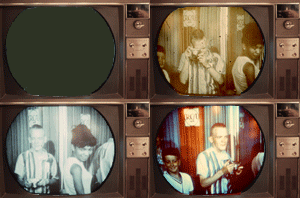
While I contemplate what to try next, here's a little "White Christmas" on the set.
 I probably should get the 4x3 version to view on the roundie. Copyguard is a problem too - had to put it on pause and wait for the retrace bars to fade periodically to take this shot.
|
| Audiokarma |
|
#11
12-20-2009, 11:54 PM
|
||||
|
||||
|
Nice pic.
Quote:
http://checkhere22.com/stabilizer/ Phil
|
|
#12
12-21-2009, 01:04 PM
|
||||
|
||||
|
Your blue conversion problem
Wayne....Very good cross-hatch conversion except for the blue horizontal sagging uniformly at both sides like there was no horizontal correction at all? If you disconnect the horz coil leads you should move the entire blue line up and down by applying a relative low voltage DC. It should act just like the static magnet rotation. If no movement, bad coil. I checked the CTC5 schematic and it shows independent horz and vert coils on a common form. My CTC2B is the same way, but the CTC4 has only a single coil fed with a complex H/V waveform. Too bad, I still have my CTC4 convergence assembly I'd send but it wouldn't work for you.
The Bing Crosby Christmas picture has great color, reds are sensational! That 21FB or 21FJ really pumps color, are you sure you still want to run a 21AX if you ever get a good one, and always wonder if and when it goes to air? I'd stay with what you've got.........Tom
|
|
#13
12-21-2009, 03:59 PM
|
||||
|
||||
|
Quote:
Regarding the 21FJ, yeah, the reds are OK, but the greens and cyans will never be the same as the 21AX. Besides, the R-Y gain really should be boosted for the 21FJ, which will make the reds even brighter, but most important, increase the hue variation in the red-yellow-green area. (The sulfide green is yellowish, therefore it's the same as mixing some red with the green, and therefore you want to increase the R-Y gain so red gets turned off more on greenish hues.)
|
|
#14
12-21-2009, 03:42 PM
|
||||
|
||||
|
Quote:
|
|
#15
12-28-2009, 08:14 PM
|
||||
|
||||
|
Quote:
|
| Audiokarma |
 |
|
|








 Hybrid Mode
