
|
|
|
#1
 08-10-2011, 12:55 PM
|
||||
|
||||
|
21-CT-55 power supply failure
The other day I installed the last of the new caps into the '55, so it's a good reliable runner now... or so I thought.
A couple seconds after it came on, the picture got all fuzzy with hum bars slowly drifting up the image. Voltage checks revealed B+ was 360 when it should be 400, and there's 36VAC of hum now. I suspected one of the new filters I installed might have bit the dust since they are only 80uf when they should be 200 (doubler circuit), but replacing them didn't fix it. I suspect the seleniums might have gone bad, so I'm going to replace them with new diodes. Trouble is new silicon outputs more voltage, so I need to know what value resistor to use. I could always just run the variac, but I don't want lower filament supplies. Can anyone with a CT55 tell me what they have done with the power supply?
__________________
Evolution... 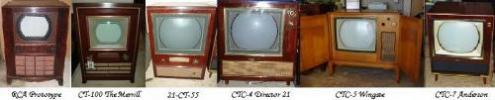

|
|
#2
08-10-2011, 03:02 PM
|
||||
|
||||
|
Nick,
I used a 7.5 ohm 25W tubular ceramic with the adjustable slider on my set. I was able to tweek the B+ right on the money. I used 1A 1000PIV diodes. I hid the resistor inside the rectifier cage mounted with a screw and fiber insulating washers through the center of the resistor bolted to the wall of the rectifier cage.
__________________
Vacuum tubes are used in Wisconsin to help heat your house. New Web Site under developement ME http://AntiqueTvGuy.com
|
|
#4
08-11-2011, 11:01 PM
|
||||
|
||||
|
IIRC, Seleniums have a forward voltage drop of about 5 to 9 volts, and a silicon rectifier has a forward voltage drop of .7 to .9 volts.
Georg Simon Ohm's little contribution says that E=IxR, and we need to drop approximately 7 volts (somewhere in the middle of the selenium voltage drop range). I'm assuming a 21-CT-55 would draw about 450 watts from the power line at 115/117V, so the current draw would be about 3 Amperes. Not all of that is B+ current, so let's say (worst case) the B+ current is 1 Ampere. It is more likely in the 550-800mA range, I suppose. Now that we know the current and voltage, getting to the resistance needed to drop that voltage is simple Algebra 0.5: R=E/I, so 7/1 gives you about 7 ohms, well within the adjustable range of Bob's 7.5 ohm resistor. My calculations/explanations are full of assumptions, and are VERY open to correction.....I just did the same math for an old 6L6-based amp, and it worked well. Your mileage may vary. Fuses are a must, I might add. Cheers,
__________________
Brian USN RET 22YRS (Avionics/Cal) CET-Consumer Repair and Avionics ('88) "Capacitor Cosmetologist since '79" When fuses go to work, they quit!
|
|
#5
08-12-2011, 05:38 PM
|
||||
|
||||
|
Nick,
The ctc4 has a 10 ohm 25W resistor in the ac side between the common lead of the diodes and 4.5A power supply fuse. The other power resistor you saw on my CTC4 chassis is original to the chassis and is somewhere else in the power supply ckt.
__________________
Vacuum tubes are used in Wisconsin to help heat your house. New Web Site under developement ME http://AntiqueTvGuy.com
|
| Audiokarma |
|
#6
08-12-2011, 10:06 PM
|
||||
|
||||
|
Quote:
|
|
#7
08-12-2011, 11:03 PM
|
||||
|
||||
|
Why not just try different values until the B+ is what you want?
Phil Nelson
|
|
#8
08-12-2011, 11:43 PM
|
||||
|
||||
|
Quote:
The net result of the properly chosen extra resistor will ensure the same ripple. Hence the resistor is chosen to match the original B+ voltage. Terry
|
|
#9
08-24-2011, 01:02 AM
|
||||
|
||||
|
those seleniums seem never to last long. I just used newer diodes in mine too and kept sels. for looks
__________________
1977 Zenith Chromacolor II A Very Modern Zenith
|
|
#10
08-25-2011, 01:22 AM
|
||||
|
||||
|
OK, so I did some poking around tonight and it's definitely not the power supply like I thought. I see no ripple when the deflection circuits are disabled, but the metal ballast is still getting pretty warm. It seems something from somewhere else in the set is causing the issue, but I don't know where to start.
Does this set have a boost cap? If so, I suspect it might be leaky. There's other caps in the HV garage that still have not been replaced, so I'll start there. Any other suggestions?
__________________
Evolution...
|
| Audiokarma |
|
#11
08-25-2011, 07:41 AM
|
||||
|
||||
|
I have the orginal seleniums in my Model 5, CT-100 and Westinghouse 15 inch. They've held up well.
|
|
#12
08-30-2011, 10:48 PM
|
||||
|
||||
|
Now it's obvious that some circuit is taxing the power supply big time, even with the sweep tubes out the ballast is getting really hot and B+ is still 15 volts low. The drain appears to be on the 285 volt rail, so I guess I'm just gonna have to start disconnecting things till the load goes away. I think maybe a cap somewhere has (partially?) shorted or something.
Also tried replacing the seleniums with diodes, didn't change a thing.
__________________
Evolution...
|
|
#13
08-31-2011, 12:23 AM
|
||||
|
||||
|
Nick, you could try measuring the resistance of the 285V circuit (with the power off and any voltage bled off). It may measure low since you have a high-current problem. The next trick is to test the "other side" of each part that branches off from that line. One of them would likely measure lower resistance than the main circuit itself, and that would be where your shorted part is.
__________________
Chris Quote from another forum: "(Antique TV collecting) always seemed to me to be a fringe hobby that only weirdos did."
|
|
#14
08-31-2011, 07:41 AM
|
||||
|
||||
|
Something just occured to me. My CT-55 chassis is sitting in the dining room so it's easy to access. If you need a resistance measurment, let me know what you'd like to compare; that may be helpful.
Regards, Mark
|
|
#15
08-31-2011, 01:29 PM
|
||||
|
||||
|
Sure, what's the resistance reading you get on the 285v line with the ballast pulled? More importantly, how much current does the 285 rail pull when working correctly?
__________________
Evolution...
|
| Audiokarma |
 |
|
|











 Linear Mode

