
|
|
|
|
|
#1
 04-11-2012, 11:42 PM
|
||||
|
||||
|
Quote:

|
|
#2
04-12-2012, 06:09 PM
|
||||
|
||||
|
21CT55 WB IQ Picture Quality
Quote:
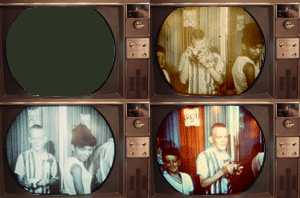
The screen-shot comparisons of my 1954 RCA 21CT55 with its full NTSC spect'd CTC2B chassis and 21FBP22A rare-earth crt produced picture quality almost comparable with my solid-state, comb-filter 1984 Pro Sony. I checked all the RCA schematics from the CTC4 up to the CTC20 tube types. All of them have narrow equi-bandwidth chroma processing and hi level crt luminance/chroma combining. The dramatic difference in picture quality between RCA’s CTC2B wide band IQ and the CTC4 NB R-Y/B-Y was obvious to me even in 1964 as related in my first AK/VK message of March 28, 2008: ”…….When I bought my 21CT55 for $50 in '64, I brought it into the house after I got it working and ran it along side my Dad's old CTC4 he left me. Both were operating Over the Air and both had 21FBP22s so it was a good comparison of narrow bw color R-Y B-Y vs. full bw color I Q. The extension of full color into fine detail on the CTC2B was startling! Color persisted in "Show of Shows" fireworks until extinction which I never saw before. The CTC4 fireworks turned into white long before extinction. The CTC2B carried full color burn all the way into black, while the CTC4 went color to gray to black! I get really awesome displays on the 21FBP22A with vibrant, accurate color shading. Having the CTC2B's super wide dynamic range due to full bandwidth I Q demodulators feeding low level I-Q-Y matrixing , resulting in pure R G B that were amplified and applied to the CRT grids only. I kept the CTC4 in the house for the kids but brought the CTC2B back to the garage workshop for further study.” The CTC4 was RCA’s first attempt at drastic cost reduction with the introduction of NB equiband high level R-Y B-Y demodulation and developed G-Y applied directly to the CRT grids, with high level luma +Y applied to the CRT common cathodes. This basic CTC4 configuration persisted with slight variations thru CTC5, CTC7, CTC9, CTC10 and beyond, producing quite acceptable quality pictures. However, only a side by side comparison in real time like I configured in 1964, would demonstrate the obvious superior fine-detail performance of the wide-band CTC2B. This is possible for the few VK members who have both an operating CTC2B and also later RCA roundys but impossible for me with only a single 21CT55 and a comb-filtered Sony Pro Monitor. I must therefore rely on the "stitched JPG" screen-shots I posted in this thread. Hopefully other VK members will attempt to duplicate the "stitched jpg" screen-shots presented in this thread using a wide-band CT100 or 21CT55 and later narrow-band RCA roundys. I could provide the original 1024X768 jpg pics I used if requested........Tom
|
|
#3
04-12-2012, 09:09 PM
|
||||
|
||||
|
Quote:
The set itself may in fact be able to produce color farther into the background but the simple fact is that the human eye, at normal viewing distance, cannot perceive them. That's why RCA and others did away with wideband after the CTC-5 series, the extra expense was not justified. It's a physiological question, not electrical. Does that mean it's necessarily 'better'? That's the subjective question. You say yes, I say there isn't a whole lot of difference when viewed at a normal distance from the screen. Quote:
Since I have a finely tuned example of each chassis model from CT-100 to CTC-7, I think my input may carry some weight on the subject. (Pete, feel free to correct me should I be wrong) Here's what it boils down to: The human eye has greater sensitivity to variations in brightness than color, which is why you don't notice much difference at normal distance from NB to WB. If you're the type that sits 12" from the screen analyzing every detail, then the WB sets may in fact provide better visual 'fidelity'. But I would submit to you that no one watches television like that, it would be nearly impossible to actually enjoy. Further, it's a fact that a B&W set from the same period produces a 'finer' monochrome picture than any color set ever will, because their luma channels are not bandwidth limited as the color sets were. Also their CRT's did not have a resolution sucking shadow mask. It's the same exact argument the audiophools always use, but when presented with 2 wildly different setups for a blind test they nearly always fail to tell the difference between the system that was more expensive or 'better'. It would be interesting to make just such a comparison live; put a card in front of a NB and WB set with the same thing on screen, and ask the viewer to pick the best looking one. These types of things are impossible via internet...
__________________
Evolution... 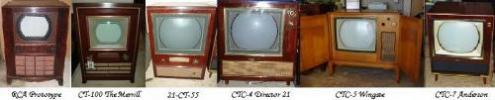
|
|
#4
04-12-2012, 10:43 PM
|
||||
|
||||
|
I remember watching rock concert performances on NTSC displays, and noticing massive limitations in resolution of scenes that were mostly black and blue (such as a shot of the drummer when only the blue overhead lights were on), and perhaps other black-plus-color scenes as well. Would this type of programming look better on a wideband-color NTSC display?
Incidentally, I am one of the people who would sit close and analyze every detail. I think a good viewing distance from a 19-inch display is probably about 30 inches maximum.
__________________
Chris Quote from another forum: "(Antique TV collecting) always seemed to me to be a fringe hobby that only weirdos did."
|
|
#5
04-13-2012, 10:23 AM
|
||||
|
||||
|
Quote:
Saturated blue objects (with details varying from full blue to black) will have the same type of loss of contrast, with the original 11% of the full black-to-white range changing to only 1%. This may be less or more noticeable than the red problem depending on the over-all content of the scene. If the scene is entirely blue, it will be much more noticeable than if the scene contains full black to white contrast and some blue objects. If the blue is deep violet-blue or purple, it will be carried in the narrow Q channel, so will not be improved by the wider I bandwidth. Last edited by old_tv_nut; 04-13-2012 at 10:30 AM.
|
| Audiokarma |
|
#6
04-12-2012, 10:45 PM
|
||||
|
||||
|
Leaving the realm of subjectivity for a moment....Video resolution(visual detail) in analog TV is directly related to bandwidth, so logic states that a measurable difference in the bandwidth between two color demodulators(or any other video system) will yield a measurable difference in resolution if all else is the same.
Whether or not this difference can be(or will be) perceived by the viewer is subjective, but the previous paragraph is scientific fact and not subjective. I'd likely notice the difference as I tend to watch my sets at a closer viewing distance than most and watch for bad details to the point of annoying even myself. LOL.
__________________
Tom C. Zenith: The quality stays in EVEN after the name falls off! What I want. --> http://www.videokarma.org/showpost.p...62&postcount=4
|
|
#7
04-13-2012, 08:53 AM
|
||||
|
||||
|
Quote:
To a point: remember, there are only so many phosphor dots.
__________________
Evolution...
|
|
#8
04-15-2012, 03:50 PM
|
||||
|
||||
|
21FBP22 Resolution
Quote:
Obviously, the quanity of phospher dots can’t possibly limit the ability of a knowable observer viewing a 20in CRT at a distance of less than 40in to determine relative picture quality. The CTC2B’s wide bandwidth I chroma resolution is 260% higher then the CTC4’s and later equi-chroma bw CTV’s resolution. Of course, this difference is most apparent on chroma resolution charts but will certainly be noticeable in any high quality natural scene and will be manifested by obvious reduction in picture quality.
|
|
#10
04-15-2012, 06:36 PM
|
||||
|
||||
|
Tomcomm, you are correct that the triad spacing does not limit the I channel resolution, but your arithmetic and nomenclature are confused.
TV resolution is not specified in line pairs, but in lines (film resolution is specified in line pairs). Furthermore, TV resolution is specified in TV lines per picture height, that is, a distance of 3/4 picture width. So, the correct number is (as you said) approx 80 lines (not pairs) per picture height per MHz, or 80x4/3=107 lines per picture width per MHz. Another way to calculate is the number of half cycles of 4.2 MHz per active scan line (~55 microseconds), or 462 lines of luma resolution. (This is a bit of an overestimate; a good rule of thumb is 440 lines per width or 330 per height.) The spacing of 664 triads per width means that the ratio of spacing to maximum luma frequency (if those sets had comb filters) would be 664/440 = 1.5. Thus, there is little chance of moire' caused by fine detail. In the actual sets with limited luma bandwidth, the ratio is a very generous 2:1. The I bandwidth is 1/2 the limited luma bandwidth, so it clearly can be carried by the screen structure without limitation. The more important ratio in the 21 inch and later color tubes is the vertical spacing of triads compared to the line spacing, because there is always the possibility of a moire' pattern caused by the scan lines interacting with the triads. Later smaller tubes, particularly the Portacolors, had insufficient numbers of triads to support full resolution.
|
| Audiokarma |
|
#12
06-03-2012, 04:56 PM
|
||||
|
||||
|
Where are you located? I might be interested. Welcome to the forum.
__________________
My TV page and YouTube channel Kyocera R-661, Yamaha RX-V2200 National Panasonic SA-5800 Sansui 1000a, 1000, SAX-200, 5050, 9090DB, 881, SR-636, SC-3000, AT-20 Pioneer SX-939, ER-420, SM-B201 Motorola SK77W-2Z tube console McIntosh MC2205, C26 
|
|
#14
06-28-2012, 07:11 PM
|
||||
|
||||
|
Oh, that's a bit far as I'm in the Kenosha, WI area. I've had bad luck with shipping things like that. Thanks for letting me know.
__________________
My TV page and YouTube channel Kyocera R-661, Yamaha RX-V2200 National Panasonic SA-5800 Sansui 1000a, 1000, SAX-200, 5050, 9090DB, 881, SR-636, SC-3000, AT-20 Pioneer SX-939, ER-420, SM-B201 Motorola SK77W-2Z tube console McIntosh MC2205, C26
|
|
#15
06-28-2012, 07:24 PM
|
||||
|
||||
|
IF you build a good double wall cardboard box with proper baffles and supports, and ship using Greyhound, you can keep the costs reasonable. I have shipped numerous 15GP22s and 21AXP22s ans 21CYP22s using Greyhound, with NO PROBLEMS!
__________________
John Folsom
|
| Audiokarma |
 |
|
|







 Hybrid Mode
