
|
|
|
#31
 05-01-2010, 04:50 PM
|
||||
|
||||
|
I watch my 52 Philco more than any set. Very reliable performer and with the help of the good people here, I have learned my way around these old sets. Welcome to the site and you have a very nicely preserved example in your Philco.

|
|
#32
05-01-2010, 04:53 PM
|
||||
|
||||
|
It needs recapped at least, the tube looks good and bright but as Marty said keep the brightness down when it's like that.
The only concern I have is it looks slightly Keystoned, a sign of a possible bad Yoke, that probably wouldn't be too hard to find for this set however. Philco loved those old "Black Beauty" capacitors, black plastic with colored bands on them, they are notorious for going bad, as are pretty much all paper caps from the era.
|
|
#33
05-04-2010, 12:06 PM
|
||||
|
||||
|
Was Hoping One Bad Tube Would Fix It
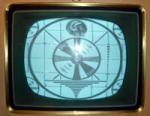
I removed the vertical osc. tube 6SN7GT and the vertical output tube 6AH4GT and had them both tested . The 6AH4GT tested fine but the 6SN7GT was below minimum output and was shorting out intermittently. I thought just maybe,just maybes would solve the problem and I would get "snow" on the screen . My luck ran out when I turned the tv on. I have the same basic pattern that I did before. What should I do next, check/replace capacitors? Thanks in advance for any input. tv10.jpg
tv11.jpg tv12.jpg thi
|
|
#34
05-04-2010, 12:13 PM
|
|||
|
|||
|
for starters you still need to turn the brightness down berore you burn the screen.
If it has paper caps you will need to replace them, no point in trying it any more until you do that. Next would be to check the electros esp any that are cathode bypass in the vert osc circuit. You could also check for continuity of the yoke and windings of the vert out transformer, but paper caps are 1st.
|
|
#35
05-04-2010, 12:25 PM
|
||||
|
||||
|
Agree, and be sure to use extreme caution when you remove the right chassis... the crt can retain a high voltage charge for days after the set has been turned off! Ground the HV wire that is connected to the CRT to a wire connected to the chassis before you attempt to remove it.
How are your soldering and schematic reading skills? jr
|
| Audiokarma |
|
#37
05-04-2010, 01:41 PM
|
||||
|
||||
|
I would replace that 6SN7 tube, as it is obviously defective if its output is well below normal and is intermittently shorting. I wouldn't be a bit surprised if that brought your picture back, although I would check every capacitor in the vertical circuit--in a set as old as yours, there are bound to be more than a few defective ones.
BTW, for replacement tubes, I've had good luck with John Kendall's Vintage Electronics: www.vintage-electronics.com. He has literally thousands of tubes in stock at his warehouse in suburban Baltimore, and they are very reasonably priced. The only thing I would watch is the shipping charges on these tubes. Although the tubes themselves are bargains, the shipping will add another few dollars to the total, depending on where you live. I'm in a small town some 35 miles from Cleveland; the shipping charges to my home for a tube I recently purchased from Vintage Electronics were on the order of, IIRC, $8-$10 or so. The tube itself only cost $2.25. There are other sources for used and NOS (new old stock) tubes as well, some of which may give you a better deal on shipping; Vintage Electronics is just a starting point.
__________________
Jeff, WB8NHV Collecting, restoring and enjoying vintage Zenith radios since 2002 Zenith. Gone, but not forgotten.
|
|
#38
05-04-2010, 05:44 PM
|
||||
|
||||
|
Thanks for the warning
I would say my soldering skills are good. Reading schematics is average. Thanks for the warnings about being zapped. I will use extreme caution. Although it may not look like it, the brightness is turned all the way down. I think it is the cell phone camera I am using. I will start replacing all of the paper capacitors and continue from there. With the help of everyone here I'm sure I will get this old tv running again.

|
|
#40
05-04-2010, 08:36 PM
|
||||
|
||||
|
Basic TV safety (maybe we should have sticky for this, guys?)
* If it's not line isolated - use an isolation transformer! * Watch the CRT - the neck is fragile and old CRTs don't have the safety feature of new ones - glass can really fly if they pop. * The high voltage 'suction cup' and horizontal sweep section - nasty when on, can hold a bad charge when off. Once unplugged, a screwdriver grounded to the chassis can be slipped under there, it'll make a little *pop* then it's safer. Touch under the cup and any other points in the HV box before going in there. * NEVER measure the horizontal output tube plate voltage - there's a multi thousand volt pulse present on it. * Don't try to look in the dark to see if the 1B3 lights up. It doesn't. Yours is fine. * The vertical section may operate at elevated voltages, also. * Be wary of electrolytic cans mounted on insulating wafer mounts - they may be at higher than ground voltage. Maybe they had a cover, maybe they didn't. * Some CRTs have metal cones. The cone will be at high voltage while the set is operating. Even with an insulation apron over it, avoid touching. * The insulation on the HV lead, and in the HV box won't prevent a shock. Just don't touch those areas! * The 'lower' B+ voltages can have upwards of 1/2 an amp to back them up! They're just as nasty as the high voltage. As always, the safest route is to turn off, unplug, and touch a grounded screwdriver lightly around the areas where you'll be working. Some sets can work with the horizontal output tube pulled out (or the fuse removed), but not all. This reduces the high voltage danger from the sweep sections greatly.
|
| Audiokarma |
|
#41
05-04-2010, 09:46 PM
|
||||
|
||||
|
Great Safety Rules
Thanks for all of those safety tips. Especially good to know for someone who is not an experienced tv repair person. I am going to print that page so that I can look it over before I remove the back cover.
|
|
#42
05-04-2010, 09:51 PM
|
||||
|
||||
|
'52 Philco L Model?
The '52 Philco I am attempting to fix is model #52-T2151. I found a service/repair guide for sale but it is for a 52-T2151-L. Could iI still use this service guide? I don't know what the L is for.
|
|
#43
05-06-2010, 01:46 AM
|
||||
|
||||
|
I think that Philco used "L" for the light oak cabinets... I would guess that the chassis is the same.
jr 1952 brochure: http://www.tvhistory.tv/1952-Philco-Brochure1.jpg Update...I dug out an old Sams Photofact listing and they show 2 listings for the model: 52-T2151 (ch 41,D1,A) .... set 171, folder #9 52-T2151 (ch 71,G1)....set 179, folder #9 No mention of "L" (light oak blond), "M" (mahogany) or "W" (walnut) however, in the index. Do you see a chassis # on the label or stamped on the chassis? jr Last edited by jr_tech; 05-06-2010 at 02:13 PM. Reason: add Photofact info
|
|
#44
05-06-2010, 03:25 AM
|
||||
|
||||
|
Wow! Great basic stuff Nasadowsk, thank you for posting it. I too printed it out and taped it to the wall in front of me at my work station. Sometimes I get into what I am doing, so much, that I can forget basic safety. A couple of thousand volt jolt can instantly refresh my memory, but I'd really like to avoid that whole death thing for now...
|
|
#45
05-06-2010, 09:29 PM
|
||||
|
||||
|
I have a feeling that that Philco may turn out pretty nice for you based on what I'm seeing so far. At least you've got something bright coming up on the screen, unlike the sea of dim grey lines I've gotten on my Zenith. We're also in the same boat far as the audio department goes... I wonder if there's a trend or pattern to the way that television sets age, and what components stop working along the way? Undeniably, the thing I hear the most often is those old capacitors. I guess it's sort of universal, be it radio, television or anything over 50 years old with a hand-wired chassis.
|
| Audiokarma |
 |
|
|








 Linear Mode

