
|
|
|
#46
 02-21-2011, 06:59 PM
|
||||
|
||||
|
Also crosses to Merit HVO-217. If I were you, Phil, I would look for a NOS replacement or a pull from some other predicta.
__________________
John Folsom 
|
|
#47
02-21-2011, 07:30 PM
|
||||
|
||||
|
That looks bad, like a lot of Philco's from that era.
I'd try Moyers for one. It might not hurt to melt all the old wax off and see what it looks like underneath but I'm betting on some turn to turn shorts, this is probably what was causing the drive line in the first place.
|
|
#48
02-21-2011, 09:25 PM
|
||||
|
||||
|
I had just finished removing the old wax and recoating it when John asked whether I had measured for continuity. It looked normal under the wax, without any obvious burned-looking holes on that side of the coil, but I suppose HV only needs the tiniest opening to escape.
I'll start with Moyers. Thanks, Phil Nelson
|
|
#49
02-22-2011, 09:08 AM
|
||||
|
||||
|
Out of curiosity, does anyone have a sense of what usually causes flybacks to fail?
I suppose overheating is never a good thing and it can readily lead to failure. But what's the typical scenario? A problem in some other circuit makes the flyback overheat and then croak? Or is there some internal factor (similar to old capacitors being imperfectly sealed against air/moisture) that means many of them are doomed to fail eventually, even if the rest of the TV works perfectly? Just wondering . . . . Phil Nelson
|
|
#50
02-22-2011, 10:26 AM
|
||||
|
||||
|
Besides too much current, likely age and insulation breakdown played a good role. That part of the circuit is a harsh environment for electrical components.
Keep an eye out for these Pomona Cathode Current Test Adaptors. They come with common cathode pins interrupted. Use an analog VOM to monitor current. I didn't have a clue what they were intended for until I started working on my first TV.  Kevin
|
| Audiokarma |
|
#51
02-22-2011, 12:52 PM
|
||||
|
||||
|
Looks like a handy gadget. I'm often too lazy to unwire something to monitor current there unless I suspect there's a problem. I've also heard of using an HP millammeter (428B) with a clip-on probe that goes over a tube's cap lead, which sounds even easier. Of course, that would be yet another 50-lb instrument to find room for
Phil Nelson
|
|
#52
02-22-2011, 01:55 PM
|
||||
|
||||
|
Quote:
 Now that you mention it, I wonder how one of those small clamp on amp meters would work that I see them at the home center. I think some of those can measure AC or DC amps. You wouldn't catch the screen current on the plate cap wire, but it would be a very close reference. Kevin
|
|
#53
02-22-2011, 02:11 PM
|
||||
|
||||
|
Then there's this thingy that I picked up at a hamfest two weeks ago. It has a tube socket adapter to measure HOT cathode current in addition to its other functions
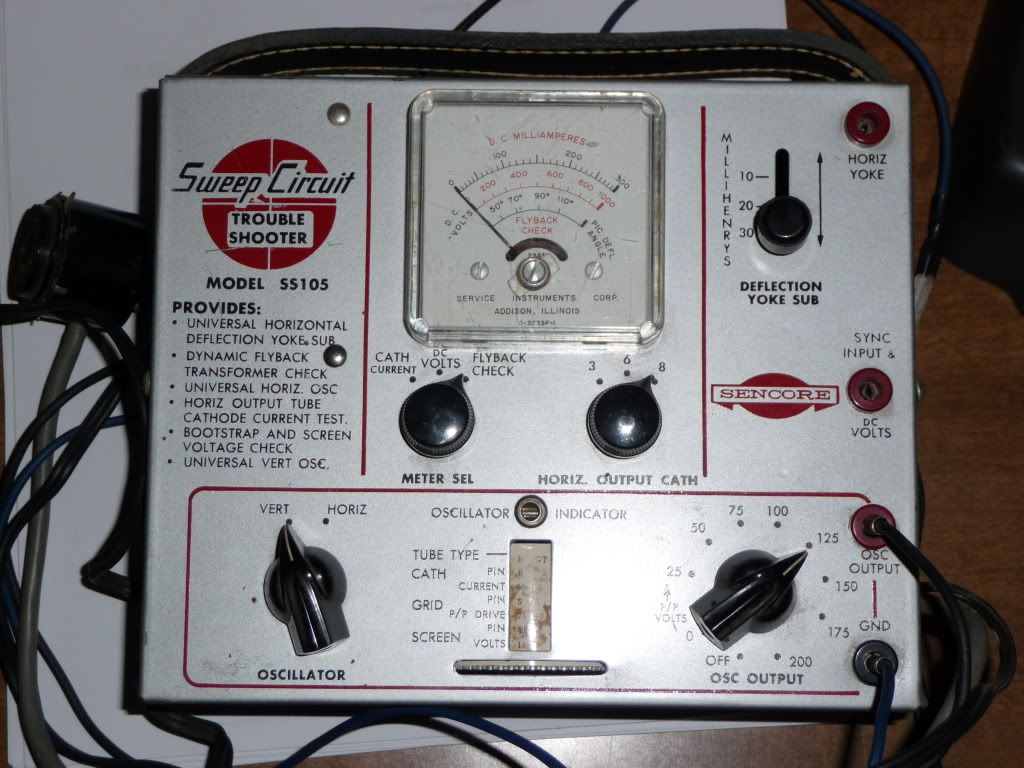 I haven't tried using it yet. I'd like to find some documentation on it first. I'm curious to know how it checks flybacks. -Clark
|
|
#54
02-22-2011, 03:04 PM
|
||||
|
||||
|
Quote:
 jr
|
|
#55
02-22-2011, 03:55 PM
|
||||
|
||||
|
jr, good point.
I think they are more aimed at electricians measuring up in the 10-100 amp range. It would be pretty easy to make one of those Pomona dealies with a tube base and socket. Kevin
|
| Audiokarma |
|
#56
02-22-2011, 05:09 PM
|
||||
|
||||
|
Quote:
http://www.amazon.com/AC-Amp-Clamp-D...=pd_sbs_auto_1 not affiliated, jr Add: While poking around on the 'zon, I came across an interesting device that might be useful for detecting potential flyback trouble spots: http://www.amazon.com/Raytek-MT6-Non...8418192&sr=8-7 Anybody here using something like that for TV work? jr Last edited by jr_tech; 02-22-2011 at 06:04 PM. Reason: add second link
|
|
#57
02-23-2011, 01:31 AM
|
||||
|
||||
|
Quote:
Meanwhile, to satisfy my curiosity, I fixed the broken wire from the coil and gave the set a brief trial. No sparks, and the picture had the same brightness as before. With a listening tube, however, I could hear faint ticking or sizzling noises seeming to come from the coil. Looking closely at the picture, I also saw very short, fleeting dashes (one scan line high) zipping horizontally across the screen. I suspect that the transformer does have internal shorts, as was suggested. Earlier, the coil had taken several minutes to get hot enough to really misbehave. I didn't let it go that far tonight. While I wait for the new part, I'll power up the set just long enough to measure the HV level and the output tube's cathode current. If those are out of whack, I'd rather find out before I've installed a new flyback. Phil Nelson
|
|
#58
02-23-2011, 09:50 AM
|
|||
|
|||
|
Quote:
|
|
#59
02-23-2011, 02:56 PM
|
||||
|
||||
|
Quote:
__________________

|
|
#60
02-23-2011, 03:53 PM
|
||||
|
||||
|
Yes, I removed the old wax and recoated the coil with black "sensor safe" RTV, and then fixed the broken wire from the coil to the HOT cap. No sparks, no corona. It makes a great picture. Listening with a tube, I can hear faint ticking or sizzling from the coil.
Making some quick measurements, I got -45V on pin 5 of the HOT and 165V on pin 4. Neither of those seems alarming. Disconnected the cathode lead at pin 8, but my DMM wouldn't give a current reading there, for some reason. I've used corona dope before, and it's good stuff. I didn't have enough left in the little bottle for this whole coil, though. Time to set this aside until the new flyback arrives, I think. Phil Nelson 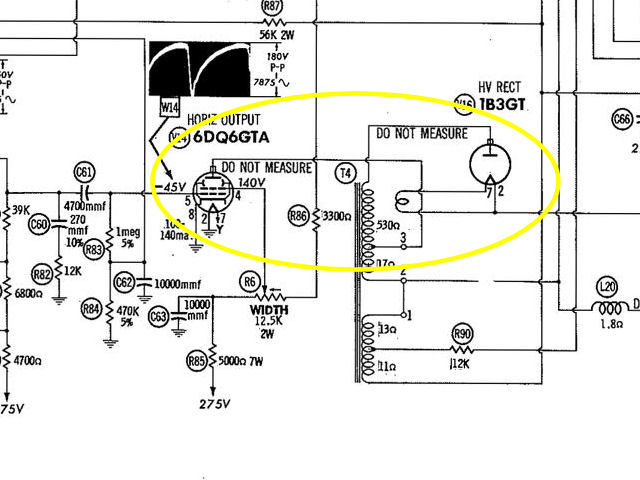
|
| Audiokarma |
 |
|
|


 Linear Mode

