
|
|
|
#121
 05-20-2011, 02:42 PM
|
||||
|
||||
|
Quote:
Hopefully I can get the 21-CT-55 up and running soon, then I will have a pic with a modern monitor, 21CYP22, 21AXP22A (grey), 21AXP22 (green), and green face 21FBP22.
__________________
Evolution... 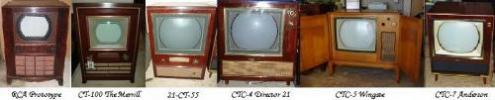

|
|
#122
05-20-2011, 04:33 PM
|
||||
|
||||

Quote:
Kevin
__________________
stromberg6
|
|
#123
05-23-2011, 03:41 PM
|
||||
|
||||
|
21FBP22A Reds vs Sonys
Quote:
Preliminary estimates of red phosphor purity of a ’88 13in Sony pro monitor, a ’97 27in Sony "modern" tv and of course the 21CT55 with 21FBP22A “rare-earth” crt follows: 21in FBA.……………Red contaminated with 5.6% green and 8.2% blue 13in Sony……………Red contaminated with 12.6% green and 6.3% blue 27in Sony……………Red contaminated with 29.2% green and 21.3% blue No wonder the “modern” TV crts appear orangish red! Last edited by Tomcomm; 05-23-2011 at 05:42 PM. Reason: Revived 27in Sony by raising white bar brightness
|
|
#124
05-23-2011, 04:27 PM
|
||||
|
||||
|
Quote:
In regards to "the red bar color should normalize to (255,0,0) RGB," I'm afraid it just ain't so, for a whole slew of reasons: the impossibility of getting ideal filters in the camera, the different spectra of the displays that interact with the filters in the camera; the raw to jpg conversion in the camera having a matrix that is designed to give pleasing color, not accurate color; deliberate non-linear S-curve processing in the camera to mimic the pleasing contrast response of film; etc. etc. etc. etc. The human eye is a much better instrument for these comparisons than a digital camera.
|
|
#125
05-23-2011, 06:33 PM
|
||||
|
||||
|
21FBP22A vs 15GP22/21AXP22
Wayne, thanks for the reply. I reran the 27in Sony by brightening the white bar. It was way too dark before which caused the red bar to saturate and as you said, "wash-out". The new results:
21in FBA.……………Red contaminated with 5.6% green and 8.2% blue 13in Sony……………Red contaminated with 12.6% green and 6.3% blue 27in Sony……………Red contaminated with 29.2% green and 21.3% blue Somewhat less contaminated but still way orangish red compared to the Sony pro and the 21CT55 with 21FBP22A. The stated 255,0,0 RGB was "ideal" with no hardware limitations. I believe this simple and cheap method of relative phosphor comparisons can be quite useful when comparing the original NTSC rated crts eg 15GP22 and 21AXP22 with the gray screen 21FBP22A. All I need is optimally setup color bar screenshots of the original GP/AXPs. I don't have much hope for a live eyeball shootout that includes the gray screen 21FBP22A, certainly not one I may witness. Last edited by Tomcomm; 05-23-2011 at 06:47 PM.
|
| Audiokarma |
|
#126
05-23-2011, 06:57 PM
|
||||
|
||||
|
Quote:
Mind you, I'm a amateur with all of this, but my two LCD monitors have two Kelvin settings that affect the color spectra - 6500K (default) and 9300K. Interesting thread! I've worked TV's for 30+ years and about all the discussion I've ever heard is from a old, now-dead TV tech that swore by the "old" RCA red versus the "new" RCA red. I guess he too would've been interested in this thread. I'm learning, keep posting! Cheers,
__________________
Brian USN RET 22YRS (Avionics/Cal) CET-Consumer Repair and Avionics ('88) "Capacitor Cosmetologist since '79" When fuses go to work, they quit!
|
|
#127
05-23-2011, 06:58 PM
|
||||
|
||||
|
Tom-
That is a very interesting test. Are you able to set the camera into a completely "manual" mode, so it doesn't do any type of color balancing on its own? If so, do you also need to pick a starting color-balance mode? I know mine has several settings for modes but I have not studied its operation very much.
__________________
Chris Quote from another forum: "(Antique TV collecting) always seemed to me to be a fringe hobby that only weirdos did."
|
|
#128
05-23-2011, 07:43 PM
|
||||
|
||||
|
Quote:
1) take the picture in a completely dark room, making sure there are no reflections (like from your shirt) 2) turn up the color control and adjust the tint if necessary to make sure only the red beam is on and the other two beams are completely cut off. 2b) Since the color demodulator may include color corrections that deliberately make the primary bars impure, you may need to readjust the tint individually for each primary color if you want to measure the green and blue also.
|
|
#129
05-23-2011, 09:58 PM
|
||||
|
||||
|
Why not use one of the TV tools with 'gun killers'? They include a feature which shunts the guns grids through a 100k resistor at the flip of a switch, though you could do it with clips as well.
__________________
Evolution...
|
|
#130
05-24-2011, 01:19 PM
|
||||
|
||||
|
Phosphor Purity Analysis
Some misconceptions regarding this phosphor spectral analysis procedure seems to exist. My objective was to evaluate its potential to determine the relative spectral purity of the original NTSC spec’d dim CRTs versus the later, brighter CRTs e.g. 21FBP22A:
1) Only previous informal archive screenshot JPGs were used. No rigorous colorbar setup was used regarding black level, chroma level or luminance (contrast) level. All screenshots were taken in total darkness. Purity and focus were always good. 2) The playback LCD monitor is used only to direct the location of the virtual pointer over the JPG image. It’s chroma characteristics contributes nothing to the JPG phosphor contamination determination. Only the Canon S40 sensor can influence the results. What is needed now is member postings to this thread their quality colorbar screenshots of their 15GP22, 21CYP22, gray 21AXP22A , green 21AXP22 , green 21FBP22 and gray 21FBP22A all taken in total darkness. Thanks for your interest and cooperation
|
| Audiokarma |
|
#131
05-29-2011, 07:49 PM
|
|||
|
|||
|
Quote:
In those days RCA designed all the IC's in their receivers. I designed the deflection processor in the CTC-146. RCA in Sommerville was the first source and Hitachi was the second source. I remember having to tweak some resistors in the 32 h input circuit as hitachi's transistors behaved a little different than RCA's. The CTC-131 chip set included a wide I demodulator and a kine drive IC with auto kine bias. Those were the days.... The CTC-135/136 was a low end chassis designed by RCA Taiwan and overseen by Indianapolis. It used a Sanyo chip that was modified to meet RCA's specs. I wish i could remember why the Wide I was removed from the CTC-133. Seems there was some reason.. I may have some of those IC's around if I can find them!
|
|
#132
05-29-2011, 08:21 PM
|
||||
|
||||
|
JBL-1, my previous post stated that I had a CTC-136B, but it's a 133B. There's a 135 in my daughter's bedroom, and it's not bad for a little Taiwan TV.
 I wasn't aware that the I wasn't wide-band in the 133. The color resolution on my set is really good when compared to the narrow band TV's in the house, and it will reproduce small detail in color, oranges and cyans, etc, but a really good picture. Interesting information, and I thank you for it. I'll look for more info on this and similar chassis where ever I can find it. Kevin
__________________
stromberg6
|
|
#133
05-29-2011, 09:47 PM
|
||||
|
||||
|
JBL_1, it's great to hear from someone involved with those sets.
The wideband IC demods were discussed in at least a couple a couple of threads here: http://www.videokarma.org/showthread...ideband&page=2 See post #19 where I gave a quick explanation the single ended delay line, which, IMO, is one of the cleverest inventions in analog video IC design I have ever seen. http://www.videokarma.org/showthread...nd#post2434742 See post #132, where I talked about my analysis of a sample RCA set with the wideband circuit while I was working at Zenith. Basically, it looked like the IF couldn't support the increased bandwidth without quadrature distortion, and the high-frequency I gain seemed to be turned down to prevent visible edge effects.
|
|
#134
12-31-2011, 06:35 PM
|
||||
|
||||
|
21CT55 Modification Progress Report 1
Hi Members...........I have returned back to my 21TC55 "lab test bed" after about six months of doing other techi stuff. When I turned it on
about two weeks ago it came right up but was totally out focus due to CRT blooming. I checked all the standard operational readings I use for setup: Room Temp=60deg, AC input=115vac, B++=424V, FBI=200ma, boost=770V, ultor=30KV, focus=5.4kv, all normal for this "experimental" setup. After one hour running, RT was 70deg, AC=115, B++=415V, FBI=199ma, boost=800V, ultor=32KV, focus=5.8KV. No CRT blooming, fine picture. I measured the CRT heater voltage direct at socket with a true RMS Fluke DMM. It read 6.16vac. I installed an old CRT booster that raised the heater to 7.64vac. The neck was much brighter of course, so I left the TV on for only a couple of hours. The set was running at 2% under spec heater all these years and now it was running 20% over spec for two hours. I turned the set off. Nest morning at 7am, RT was 54. I powered up with booster off, the 21CT55 came up with no bloom in perfect focus! Readings were AC, 115V, B++, 420V, FBI, 200ma, boost, 860v, ultor, 33KV, focus, 5.6KV, heater read 6.01vac. After about 4 hours running with fans off, RT, 74deg, Ac, 115vac, B++, 422, FBI, 190ma, boost, 780v, ultor adjusted to 30KV, focus, 5.7KV, heater, 5.93vac. No blooming, good picture so I measured the FBX temp with digital thermo meter applied direct to primary and EHV secondary. Max temp was 112deg, barely warm! Pleasant surprise, the CRT shutoff uniform glow problem was greatly reduced, almost unnoticeable! Could it be the 21FBP22 running low heater all these years allowed contamination to build-up on the cathodes causing loss of emission and/or causing grid emission that produced the glow? In-the-day the CRT boosters were quite poplar for restoring brightness and were left in place running at close to 8vac which shortened CRT life considerably. I always took them off after a few days/weeks, often with no noticeable decrease in brightness or increase in blooming. I still have this problem with the hybrid combination of original CTC2B horizontal oscillator and 6CB5 HOT driving a CTC16 flyback xformer and associated components, driving the original CTC2B yoke. This mismatch works fine but since it has no width control and only limited centering control, the screen is over scanned about 2 inches and is off center about 1 inch. This is unnoticeable except on test patterns.The BIG problem is the very noticeable horizontal video "fold-over" on the left screen presumably due to the horizontal sweep flyback starting up before the previous field's video is blanked? The magnetic horizontal deflection of color CRTs is probably the most heavily engineered, most critical component matching requirement, highest efficiency consumer electronic system of the 1950s. It obviously does not permit the "hacker" approach to customizing I usually pursue. I've tried all the usual modifications using all combinations of resistance, capacitance and inductance to reduce the horizontal width and enable horizontal centering with no success and almost tragic results. Soooo, I am now designing a video blanking circuit that cuts off the foldover contaminated video for the first portion of every video line. It starts immediately after the chroma burst and extends three microseconds which completely removes all visible traces of video foldover from the screen. Once I get this circuitry installed into the CTC2B under-chassis I will do a painful optimal convergence and be ready to take a batch of screen shots with Judy's new Sony DSC-HX9V 16.2 mega pixel pocket camera. The CTC2B with "gray screen" 21FBP22A CRT combination has an extreme dynamic range that displays to the human eye details into deep shadows that our other cameras failed to capture. Hopefully, the Sony camera has a greater low-light dynamic range? The video gate module is now installed, works perfectly! I'll probably do a convergence tomorrow and if I survive I'll take some screen shots with the Sony..........Tom
|
 |
|
|






 Linear Mode

