
|
|
|
#1
 10-06-2014, 06:07 PM
|
|||
|
|||
|
Sentinel 400 Width
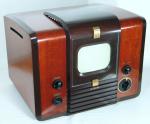
I'm restoring a Sentinel 400. After recapping and replacing out of tolerance resistors, it was playing rather well except the picture had a horizontal jitter. I posted about that on Antique Radio Forum, and was told the jitter was probably because I hand not put the HV cage back on yet.
Upon reinstalling that, something inside the cage started arching. I turned the set off, removed the cage and couldn't see anything that was near the cage that would cause an arch. I put the cage back on, powered it up, and it arched again, but stopped after about 15 seconds. Then the horizontal width had shrunk. I have checked, rechecked, and replaced every resistor and capacitor in the HV cage. All voltages on both the Horiz Osc and Horiz output tubes are ok. I've subbed new 6SN7 tubes for the horiz osc and output, a new 6Y6 for the HV oscillator, and tried another 6X5 in the LV rectifier. I've also replaced all the dropping resistors in the string too. I'm out of ideas. Any help is greatly appreciated. Thanks Doug 
|
|
#2
10-06-2014, 08:42 PM
|
||||
|
||||
|
Something you replaced possibly not usable at the high voltage....?
One of the screws to the HV cage hitting something underneath. You have to look at it as a new problem, treat the symptom you now have.... Check the B+ short narrow picture.... .
__________________
Yes you can call me "Squirrel boy"
|
|
#3
10-07-2014, 07:52 PM
|
||||
|
||||
|
Here's what I would do to track this down:
1. Confirm that you have 600+ volts coming off the 6X5 to the top of the resistors feeding the horizontal output tube. I believe you have already done that. 2. If you have a scope, check to see that the sawtooth waveform on both plates of the horizontal output tube span almost the full available voltage -- which is zero to 600+ volts. 3. Try replacing both of the 600 V horizontal coupling capacitors. You obviously already replaced these, but I have seen one case where one of these failed by moving it around too much while working on the set -- the connection from the lead to the internal parts of the capacitor broke from handling. If there is a problem with #2 above, then check the waveform on the grids. Both should show similar amplitude. Note that one grid feeds off the plate of the other triode via a capacitor and resistor voltage divider. If that grid doesn't have the right signal, the problem is in that voltage divider. If you don't have a scope, it will be more difficult to track this one down. However, I would work under the assumption that one of the two deflector plates is not getting the right signal, since it looks like your raster is about 1/2 the proper width. Try shorting the grid to ground on the triode that gets its signal off the plate of the other triode (that will leave one triode functioning normally). Does it affect the signal? If so, then that triode is working to some extent. If it does not, then you know for sure that that triode is not functioning properly. Hopefully that all makes enough sense. If not, I can add some references to specific components from the schematic...
|
|
#4
10-08-2014, 08:03 PM
|
|||
|
|||
|
Well I found the problem with the width. When I had reinstalled the HV cage and something arched, a couple of mica caps had shorted in the hoirz osc circuit. I replaced the mica caps on both the plate and grid of the 6SN7 horiz osc and not have good width.
However, the original problem was still there. Every time I would try to reinstall the HV cage, I will get a wide black bar across the screen and something starts burning under the chassis. I couldn't see anything under the HV sub chassis that would be arching to the cage, but I coated all joints with HV Corona dope. Finally I decided to try to place the cage on with the set running. I then noticed some arching from the flyback coils to the cage. I coated all the flyback coils with corona dope and was finally able to install the cage. However, after I got the width fixed, I noticed I now have 2 vertical half frames, so I'll start checking voltages on the vertical circuit next.
|
|
#5
10-08-2014, 10:32 PM
|
||||
|
||||
|
When you have two vertical half frames, it means that the vertical oscillator is running at twice the correct frequency. Sometimes all you have to do is adjust the vertical hold control differently. If there isn't enough range in the vertical hold control to bring it to the correct frequency, check resistors and capacitors in the vertical oscillator stage. Make sure all resistance values are on target, and the capacitors match the values in the schematic.
Your picture looks a little strange. You might be running at 1.5X the correct frequency, which should not lock all that well.
|
| Audiokarma |
|
#6
10-09-2014, 08:51 PM
|
|||
|
|||
|
I think I've got it. I replaced both the vertical osc and output tubes and was then able to adjust the controls to get a stable pic.
It just passed a 30 min bench test. The only thing I noticed was a white horiz line towards the upper part of the screen. You can see it going across the man on the left's head, above his left ear. I think I got most of it eliminated by tweeking the vertical lin control.
|
|
#7
10-09-2014, 09:43 PM
|
||||
|
||||
|
Those dashes (which I assume are constantly changing ) are the digital encoded closed captioning data. They are normally out of sight, located in the vertical blanking "bar". It appears that your vertical scan is quite non linear (stretched at the top) to the degree that the vertical sweep has "folded over", placing the CC data into the picture area. Fix the linearity and the CC data dashes will end up where they should... out of sight, above the picture area.
jr
|
 |
|
|




 Linear Mode

