
|
|
|
#1
 06-29-2009, 10:12 PM
|
||||
|
||||
|
C-M Roundie and CC-II SC score!
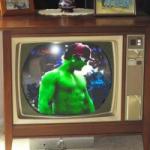
Finally I got my hands on a true roundie! Found this Curtis-Mathes set at an estate sale literally 100 yards from my house. This place was truly a time capsule from the mid-50's, not a single thing touched since the house was built and originally decorated.
The house was built on an unusual sloped lot (well, for flat Texas it's unusual!). I didn't even know it had a basement that opened on the back yard! The upstairs was the lady's domain, and the downstairs had the original "Man Cave", a large den with a Gibson marshmallow fridge built into the wall for the beer, a bar with serving area, roman brick fireplace, "modern" clock built into the wall, and red/white/green square linoleum tiles with swirlies in the pattern. Even the lamps were dead-on mid-50s. Back to the score -- A large C-M Console with a custom-fit glass top. Maple cabinet, and not a scratch on it! Electronics not so much, it had total vertical collapse and horrid convergence. Time for a recap I'm sure. This model look familiar to anyone? Also got a mid-70's 17"(?) Zenith SE-1750 Chromacolor II with a 3-button Space Command. Has a neat almost-Avanti styling. All operation is perfect, but unlike my other tube-type SC400 set, this one doesn't seem to scan to the "next" active channel. Testing it just prior to the analog shutdown, it only steps one channel at a time. Normal or anomoly? 
|
|
#2
06-29-2009, 10:29 PM
|
||||
|
||||
|
Nice! I'm sure that CM uses an RCA clone chassis.
Does the CCII have a rotary varactor tuner or a vertical row of channel numbers with a door that opens to conceal a tuning thumbwheel next to each channel number? The very first color TV that I fixed was a 19" Zenith SC with the vertical numbered varactor tuner. IIRC, it did not have provisions for skipping channels.
|
|
#3
06-30-2009, 12:05 PM
|
||||
|
||||
|
Quote:
The all-electronic tuners in today's TVs can be set to skip unwanted channels by means of a "delete" function on the set's main menu. This is supposed to be far easier than fussing with tuning in channels with a tiny thumbwheel on electronic varactor tuners and replacing acetate channel tabs on the selector panel or drum, but some people don't or cannot even grasp the new system, which is why one often sees TVs receiving every available channel in an area, including infomercial stations and other barely-watched channels. Most non-technical people these days buy a TV, take it out of the box, set it where their old TV was, connect the cable or antenna, and watch it, not even bothering to set the tuner for their area's local stations. This can cause some real problems in this new age of ATSC digital television (many people don't know how to "rescan" a TV or converter box when the DTV stations change channels, then wonder why they cannot receive certain channels they could receive perfectly well in analog), but in the days before digital, almost all sets made from the '80s until the end of analog were designed to be used out of the box with no setting/scanning channels or other setup required, except for connecting the power cord and the cable or antenna. HDTV flat-panel sets are not nearly that easy to set up, as flat-panel sets often require professional calibration; another problem is the sound. Most large-screen HDTVs (except the small Philips-Magnavox, et al. 15-inch sets) do not have their own speakers and require an additional "home theater" audio system, at an extra cost to the viewer. It seems to me as if the FCC and the HDTV industry, respectively, are forcing viewers, by degrees, to convert to digital HDTV flat-panel televisions and 500+-watt audio systems, whether the viewers want to do so or not--unless, of course, they are willing to settle for a 15-inch picture. The other thing the industry fails to realize, IMHO, is that apartment dwellers, for the most part (unless their apartment is rather large and the residents have a very accomodating landlord), are not in a position to install 50"+ flat-panel TVs with powerful home-theater sound systems in their apartments. Most home-theater sound systems are very powerful, capable of producing window-rattling volume; one night of listening to a movie or TV show with a lot of sound effects will often be enough to cause the landlord to contact the tenant (after the former receives complaints from other tenants of "that noise in apartment 3-A"), asking at first that he or she turn down the volume. If this happens a second time, the tenant faces eviction, as loud music, TV program sound, etc. will not be tolerated in any apartment complex. BTW, I think it was a tremendous waste of time and money to convert to ATSC digital the stations that run only infomercials. These stations obviously have some viewers, but by and large most people ignore them because they are what amounts to one all-day and all-night infomercial, and as we all know, viewers hate TV commercials. What was the value of converting these stations to DTV? I think the FCC should have offered full-power stations that run basically infomercials or other little-watched programming the option of remaining with NTSC until or unless the stations decide to abandon infomercials for standard television programming. There are two such stations in this area, both of which are watchable on cable as they are must-carry channels here: channel 67 and, to a lesser extent, channel 23, the ION-TV affiliate (both are not even in Cleveland and cannot be received without cable). Channel 23 has regular TV shows, and even some classics, but after about ten o'clock p.m. EST they switch to infomercials until shortly before prime time the next day--there is no standard television programming (yup, you guessed it, just infomercials) on this channel all day long, from about nine a.m. until 4 p.m. and 10 p.m. until 9 a.m. EST.
__________________
Jeff, WB8NHV Collecting, restoring and enjoying vintage Zenith radios since 2002 Zenith. Gone, but not forgotten.
|
|
#4
06-30-2009, 01:07 PM
|
||||
|
||||
|
Jeff, I do not understand why a discussion of how to set up an old TV's tuner drifted off into comments about whether infomercial stations should have switched to ATSC, but I do need to respond to two comments you made that do not match anything I have seen while studying a lot of recent equipment:
Quote:
2) I have not seen a flat-panel TV without built-in speakers in any store recently, except maybe a few specialty high-end displays that will not be bought by average consumers. EVERY flat-panel TV at a Wal-mart, Sears, Best Buy or similar store will have built-in speakers and a very decent picture out of the box. The chance that buying a new flat-panel TV will "require" a home-theater audio system that could lead to being evicted after two nights of movie viewing is just plain absurd. I'm sorry, but I have no better/nicer way to put this.
__________________
Chris Quote from another forum: "(Antique TV collecting) always seemed to me to be a fringe hobby that only weirdos did."
|
|
#5
06-30-2009, 01:10 PM
|
||||
|
||||
|
Getting back on topic, the sets bought by ha1156w, I noticed that the Curtis Mathes CRT has no "cataracts". Are some climates and/or CRT brands less likely to have that problem? That should be a nice TV when it is restored.
__________________
Chris Quote from another forum: "(Antique TV collecting) always seemed to me to be a fringe hobby that only weirdos did."
|
| Audiokarma |
|
#6
06-30-2009, 03:00 PM
|
||||
|
||||
|
Quote:
Do you live in your own home or in an apartment? If the latter, I don't think you should challenge anyone's remarks (mine or anyone else's) regarding this subject. I live on the first floor of a two-story, 12-unit apartment building and cannot make loud noises at any time; in fact, the village in which I live has a noise ordinance as well that prohibits loud noises anywhere in the village after ten o'clock p.m. If I lived on the second floor of this building I would be walking on eggshells as far as even listening to my stereo system, let alone my television, through its speakers is concerned, for fear of incurring the wrath of the other tenants or even the landlord. I am not trying to win popularity contests with my posts to this or any other AudioKarma forum. If you agree with what I have to say, great, but if not, please do not condemn my remarks publicly as you just did. If you must disagree with anything in my posts from now on, I suggest you send me a private message containing your gripes.
__________________
Jeff, WB8NHV Collecting, restoring and enjoying vintage Zenith radios since 2002 Zenith. Gone, but not forgotten.
|
|
#7
06-30-2009, 07:39 PM
|
|||
|
|||
|
The Curtis Mathis Roundie that was found was probably assembled in Athen's Texas, where CM had a factory. I cleaned out a TV located there and have a couple of these in my garage and some CM chassis. (If parts are needed, please feel free to contact me). The reason for not having cataracts is probably that the CM set uses the CRT that does not have the safety glass bonded to it(21FBP22?) At least this is what mine uses.
As to the debate concerning CRT vs flat screens, I have an LCD monitor that has lasted 5 years without problems. Because of this I suspect that at least the LCD flat screens should be ok. However, the CRT sets(at least the solid state ones) do have one advantage over the flat screens. They use less electricity. My big issue with DTV in general is it's poor reliabilty vs the analog system, especially in bad weather. If the bandwidth had truly been used only for emergency services, I could possibly have lived with it. But since 90%(as I understand it) went to people like Verizon so they could continue to rip us off, I think it is criminal. TV is an emergency service in some areas of the country during severe weather and should have remained reliable.
|
|
#8
06-30-2009, 09:03 PM
|
||||
|
||||
|
Quote:
BTW, I did not realize that ninety percent of the bandwidth given up by analog TV stations, when they went exclusively to digital, was grabbed by wireless service providers the likes of Verizon and others. ("Ripped us off" is right!) After Hurricane Katrina, I was sure the plan was to allocate this bandwidth to emergency services, so that communications problems such as the ones encountered during that storm would not happen again. (It wasn't and they will, respectively.) When the bottom line (read money) becomes more important than improving such things as emergency services, I cannot help but wonder where along the line Washington's priorities got mixed up as badly as they are.
__________________
Jeff, WB8NHV Collecting, restoring and enjoying vintage Zenith radios since 2002 Zenith. Gone, but not forgotten. Last edited by Jeffhs; 06-30-2009 at 09:10 PM.
|
|
#9
06-30-2009, 09:12 PM
|
|||
|
|||
|
Another issue(at least at present), is that there are almost no battery operated DTV sets. At least with the analog system, you could watch a battery operated set when power(and most likely, the cable/Satellite TV system) was down. Hopefully, this situation will change.
|
|
#10
06-30-2009, 10:56 PM
|
||||
|
||||
|
Quote:
I think you are entirely right that using a high-power home-theater sound system at full volume is likely to lead to possible eviction if done in a small apartment.  Thank you for the notes about the CRTs, peverett. The one in the first post looked like it might have the bonded glass.
__________________
Chris Quote from another forum: "(Antique TV collecting) always seemed to me to be a fringe hobby that only weirdos did."
|
| Audiokarma |
|
#11
06-30-2009, 11:15 PM
|
|||
|
|||
|
As well as my LCD flat screen monitor that is 5 years old and has not given a bit of trouble, I also have a Sanyo analog CRT based TV(on cable) that is around the same age (5 years) and also has not given a bit of trouble. Both are used every day. From this sample of one each(far to small of course), it would appear that the reliability is the same. Probably not, but I would venture that they are close, considering the solid state electronics contained within.
|
|
#12
07-01-2009, 02:33 AM
|
||||
|
||||
|
Regarding power consumption,,,, A CRT set will almost always use more power than an LCD of equal screen size. It's the plasma TV's that eat a lot of electricity (and throw tons of heat).
Nice finds. I think high humidity levels play a major part in whether or not a crt will develop " cataracts " - since the dampness tends to make the adhesive more malleable... 
|
|
#13
07-01-2009, 09:24 AM
|
|||
|
|||
|
Where is this power data concerning LCDs vs CRT based sets? LCD sets require a back light while the CRT only requires lighting the CRT heater. I would say the CRT heater requires less power than the back light. Why would the electroncs in the CRT based set require more power than the LCD based sets?
I admit that Plasma sets are power hogs. Large screen LCD sets are also(place your hand over the upper vents of one that is operating if you have doubts). There is a couple of drawbacks to CRT sets that I think have already been mentioned. 1. The screen size is limited. 2. They are usually standard definition.
|
|
#14
07-01-2009, 09:52 AM
|
||||
|
||||
|
Quote:
 I think you got derailed. Trying again toward the topic; I've worked on a lot of those early Zenith Chro-II sets with electronic varactor tuners. They have a pop-out panel inside the door which has 12 or 16 tuning wheels; each capable of tuning any channel VHF or UHF. To have it tune directly through channels, just set the wheels one at a time to your local channels, and that way there aren't any empty ones between. If I'm not mistaken, those sets came with empty black squares to slip into the channel display strip, which would cause the selector to skip the blacked out position. But I can't remember now if that was on these early ones, or even another maker. It's been a long time... Charles
__________________
Collecting & restoring TVs in Los Angeles since age 10
|
|
#15
07-01-2009, 11:34 AM
|
||||
|
||||
|
Well, I'll say this: the C-M is a great find, especially in that condition. And right next door, too! It should come back pretty easily-the vertical could be a bad resistor, bad pot, or maybe an intermittent somewhere in the circuit. (or, of course, a tube) Outside of the filters the caps on sets this age tend to age well.
That looks like a CTC-15 clone. As for the lack of cataracts, I would like to see a study determining what conditions caused them to worsen. Moisture seems to be a big part of it. This tube should have a safety glass but I'm guessing maybe it uses the crt with the gasket-fitted glass, not the bonded version. That mostly seemed to show up in less expensive models but who knows?
__________________
Bryan
|
| Audiokarma |
 |
|
|








 Linear Mode

