
|
|
|
#1
 05-17-2012, 01:19 PM
|
||||
|
||||
|
weird vertical sync problem RCA 8-PT-7010
I haven't had time to work on TVs in months. I got stuck on this problem with this set back in December, and haven't had time to get back to it until now.
The vertical will only sync if I feed the tv with a weak signal. If the signal is strong enough for a clear picture, no snow, it won't sync. First of all, I would think this has to be a problem with the sync separator, not the vert oscillator. I took voltage readings, and found voltages were a little high pretty much everywhere in the set. (Probably because I replaced the selenium rectifiers with 1N4007 diodes) I put dropping resistors in the power supply, but this made no difference to my sync problem, and gave off tons of heat, so I'll probably leave them out in the end. Secondly, I tested each component individually in the sync separator circuits. Nothing tested more than 20% off from what it should be. But I eventually replaced all the resistors and capacitors, and tried several different tubes anyway, with no positive results. Eventually, I figured if too strong of a video signal was upsetting the sync, then too much of the video signal was getting into the sync separator, so I increased the value of the capacitor I circled in the schematic I attached below from 10pf to 130pf (attaching a 120pf mica cap in parallel). I tried several different values, this worked best. The scope pictures show first what is going into the grid of the sync clipper tube, and second the output of the sync separator into the vertical oscillator, both with and without the extra capacitor. I labeled on the schematic exactly where I connected the scope probe. Now this extra capacitor fixes my problem, the vert sync is very strong with it in there, independent of the strength of the signal the set receives. (Both with or without the extra dropping resistors in the power supply) I'm getting ready to just put it back together with the larger capacitor in there, but I'm still wondering why I needed it in the first place? Last edited by Adam; 08-21-2015 at 01:50 AM. 
|
|
#4
05-17-2012, 01:59 PM
|
||||
|
||||
|
About 35 volts on the plate, -0.5v on the grid. That's taken with no signal input, to compare to the voltages on the schematic. With signal input the voltage goes up to about 65v on the plate, -4.0v on the grid.
My dropping resistor in the power supply that I experimented with will drop the voltage to around 40v on the plate with a signal, 30v without. It doesn't have much effect on the grid voltage. The additional capacitor I added barely effects the grid voltage as seen on the vtvm, but the effects were visible on the scope, as I posted above. For V102B: about 36v on the plate whether there is a signal applied or not. 0v on the grid with no signal, about -0.8 with. Last edited by Adam; 05-17-2012 at 02:19 PM.
|
|
#8
05-17-2012, 02:28 PM
|
||||
|
||||
|
I don't have my sams easily accessible, I never unpacked them when I moved from MI to TN last summer, so they're sitting in boxes underneath a lot of other boxes. And now in Aug. I'm going to be moving back to MI, so I'm leaving them packed. What I'm looking at is "RCA television service data 1955-1961," no waveforms posted in this.
The range of the contrast control is good, I can get a sharp picture, a blurry picture, or a picture where the contrast is set too high. The picture is actually very good on this set, I just had this weird problem with the vertical sync.
|
|
#9
05-17-2012, 02:38 PM
|
||||
|
||||
|
Quote:
Here is the probably the source of my problem. And while the capacitor I added fixes it, it's not so clear what is ultimately causing it. It's not the tube, I've tried several different ones in there. And messing with the plate voltage really doesn't fix this either.
|
|
#11
05-17-2012, 04:59 PM
|
||||
|
||||
|
This article includes the RCA service manual:
http://antiqueradio.org/rca16.htm Regards, Phil Nelson Phil's Old Radios http://antiqueradio.org/index.html
|
|
#12
06-26-2012, 05:41 PM
|
||||
|
||||
|
Getting back to this set again... Looking at that manual, I can tell that my problem was that the p-p voltage of the waveform at the grid of 1st sync (V103B) was about 2x too high. That's what my extra capacitor was correcting. But I noticed I had the contrast control all the way up, with the contrast turned far down - I had the opposite problem, the signal getting into the grid of V103B was barely there at all - which also results in no vert sync. There was only a very narrow range where I had no sync problems.
The contrast control measures 10k across - it looks like an original part, but the schematic says it should be only 4k. It is an RCA part, but the part #'s don't match. Last edited by Adam; 06-26-2012 at 08:03 PM.
|
|
#13
06-26-2012, 06:19 PM
|
||||
|
||||
|
The contrast control in this set is responsible for controlling degeneration in the cathode of the video amplifier tube, and as a result, the strength of the sync signal. If you put the correct control in, it might fix the problem since it's more than double its stated value. If it doesn't, try adjusting AGC till it's in a range where you can live with it (if AGC is adjustable). You can also try putting a 5k resistor across it, which would lower its total resistance to around 5k. That's a lot closer to spec than the 10k it's reading at now.
__________________
Evolution... 
|
|
#14
06-26-2012, 07:06 PM
|
||||
|
||||
|
Putting a resistor across it was what I was thinking to do. I wrote a long post about it, but I was thinking about it in the way that increasing the resistance would increase the output of the video amp tube, but then I realized that that's completely wrong - it's the opposite, decreasing the resistance increases the output. So I deleted my post quickly, hoping not to look like a total fool.
 So adding the resistor across it would only keep the output of the vid amp tube, and hence the signal entering the 1st sync tube, from getting too low - it would lower the max resistance, when the control was all the way out it would be like 10k in parallel with whatever else I put in there. But on the other end the min resistance would still be 0. It wouldn't solve my original problem where the p-p voltage of the signal entering the grid of the 1st sync tube was too high with the contrast control cranked up. But if keeping my extra capacitor in there, in addition to this resistor will let it sync no matter where I put the contrast control, I could just leave it in there. Or I suppose I could also put a resistor in series with the control as well and really try to limit it's range. The AGC isn't adjustable.
|
|
#15
06-26-2012, 07:57 PM
|
||||
|
||||
|
So with a resistor across the contrast control, I don't loose sync when the contrast is adjusted all the way down.
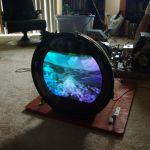
But I still have the same problem with the contrast turned all the way up and a strong signal into the set (connected directly to the modulator as opposed to using the rabbit ears). Putting a resistor in series with the control to limit the high range sort of works, but the sync is still pretty weak with the contrast as high as I like it. That capacitor I added in earlier seems to be a better solution. With that capacitor I get good sync throughout the range of the control (as long as I have the resistor in parallel with it so the total resistance of the control doesn't go too high). So with both the extra resistor in parallel with the contrast control, and extra capacitor from the grid of the 1st sync tube to ground, and about 80 clip leads  - I get sync throughout the range of the contrast control, and a good picture. See pics below. - I get sync throughout the range of the contrast control, and a good picture. See pics below.
Last edited by Adam; 08-21-2015 at 01:50 AM.
|
| Audiokarma |
 |
|
|





 Linear Mode

