
|
|
|
#1
 06-07-2012, 12:39 AM
|
||||
|
||||
|
RCA 621TS restoration -- in pictures
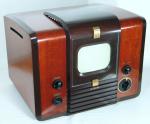
I've got an RCA 621TS on the bench, which I'm restoring for someone else. I thought I'd show some of the progress in pictures as I work through the process. This one has turned out to be relatively easy, so it's not as challenging as some, but perhaps still interesting to follow the progress on.
Someone else will be refinishing the cabinet on this one, so I'll only discuss the chassis work here. First thing I noticed when pulling the chassis out of the cabinet was some grass coming out the bottom. I worried a bit, expecting the grass got there by means of a little critter, which would likely have left urine and feces as well (what a mess!). This one is a bit different, however. Just a single stalk of grass that grew up through a hole in the bottom of the cabinet, wound its way around inside the chassis, and came out through the top in a few places. I wish I had taken a picture before I pulled it out, but here are some of the remains: The top of the chassis was pretty clean, although someone had pulled all the tubes they could easily recognize and get to. Notice how they missed a metal 6H6 (doesn't look like a tube to some folks), tubes with shields, and a few tubes that were hidden from view from the rear: I've removed some of the covers in the above photos; all the covers are in fact present on this set. The 7DP4 CRT came to life in just a few minutes on the tester and tested very good (great news!). Missing tubes were replaced with tubes from my stock (I had all of the ones needed, and even managed to find RCA tubes for almost all of them). Since bad power resistors are often a problem on this set, I checked all of them -- both the ones in the HV cage and those in the chimney on the back. Good news -- they're all good! The owner of this set requested that I restuff the electrolytic and paper caps. I don't normally do that for my own sets, but I'm actually looking forward to doing that on this one. First a set of pictures like this from various angles to document the underchassis component positions (I'll refer to this later as I put the restuffed caps back in original positions). Since I don't want to go through all the trouble of restuffing caps at the very start, and put off the actual bring up of the chassis until all that is done, I'll do things a little differently than some of you might at this point. First I thought I'd see if the electrolytics could be reformed. I seldom bother trying to do this, but have noticed that a few other restorers do this and leave the caps in place. I don't intend to leave them; I'm just looking for a temporary short cut. So I ran the set at low voltage on a variac for 30 minutes or so while monitoring the B+. The entire time I tried this, it was evident that the B+ was too low, indicating something drawing way too much current. So I gave up on reforming, and temporarily subbed new caps under the chassis. Since these new caps are going to be stuffed inside the original cans later, they are literally lap joint soldered with full length leads and various connections hanging in mid air (see picture at very bottom of post). Everything made to come apart again once the chassis is up and running. With the new electrolytics, the B+ comes up just fine for a moment. After a few minutes of observation - POW! One new electrolytic explodes. Hmmm... Why? Four of the five electrolytic can capacitors have no markings, since they are covered with featureless black sleeves. So I'm relying on the schematic for values and voltages. Shame on Rider! (or possibly RCA) They have the voltages for C128A and C128B reversed! Rider shows both at 40 uF, with C128A at 450 VDC and C128B at 150 VDC. Quick inspection of the schematic shows this can't be right. C128B is the first filter after the 5U4 rectifier. It gets the full B+ voltage -- POW! C128A is the one that only needs to be 150 VDC. I bet I'm not the only one to have this happen, since Rider is the only schematic out there for this set. After putting a 450 VDC cap in place of the one that exploded, I bring the voltage on the variac up to 100 VAC or so, and check the horizontal oscillator to see if it's working. It is, but very erratically, and at the wrong frequency. So I replaced the paper capacitors (and a few micas) in the horizontal oscillator and output stages. Firing up the set again, we see a nice horizontal drive waveform: And better yet, there is some high voltage. The flyback is working OK. So how lucky am I going to be here? Let's try putting the CRT in and see if we get a raster. First attempt: No raster -- a completely dark screen. Naturally I suspect the problem is the ion trap. I try some permanent magnet ion traps with no luck, thinking that perhaps the ion trap is open or not properly powered. Checking the original ion trap reveals it is OK. By luck I manage to notice that at the moment of shutting off the set, I get a little glimmer of light in the CRT. I checked the cathode grid voltage on the CRT, and the grid is way too negative. That's why the screen is black. I add a socket extender with test points, and short the grid and cathode together. Viola! We now have something on the screen, but it's just a horizontal line. The vertical deflection is not working. Seems reasonable, since I have not recapped that section yet. After recapping, it works no better. Time for some real trouble shooting. Checked the resistors and found none to be way out of whack. Started probing voltages, and find that the grid voltage on the first triode of the vertical oscillator is too negative. Further tracing isolates the problem to the horizontal hold control. The wiper is shorted to chassis with a 330 ohm resistance (on a 1M pot). Seems like a whisker problem. I brushed the area around the lugs with a toothbrush, which is often enough to cure this problem. No luck. Removed the control. Still shows the short. Disassembled the control. Can't see anything wrong with it. It had some whiskers on the outside of the housing, but inside looks very clean, and this one even has an insulating ring of bakelite on the inside of the housing, so it's not obvious where the short could be. Anyway, once it's apart, whatever was causing the short is gone. Reassemble and test again -- still OK. Remount back in the chassis. Vertical deflection now works fine. At this point, I'm still running with the CRT grid and cathode shorted; otherwise the picture is black. A little checking reveals that the HV bleeder resistor stack (which plays a role in the brightness circuitry) has bad resistors in it. These are a string of 2 watt carbon comp resistors, each with value in the 10+ megohm range. Most are high, and one is completely open (although it looks perfectly nice to the eye). I don't have any suitable 2 watt resistors, so I create some subs with 1 watt resistors in series and install them. Still no raster unless I short the cathode and grid on the CRT. I have not recapped the video amp at this point, and a quick check of the circuit reveals that I need to do so. After recapping the video and IF sections, we have a nice raster. Feeling lucky, I connect a signal source. How lucky can you get? The set happens to already be on channel 3, and tuned well enough for a very nice picture. A little fiddling reveals that in fact the tuner contacts are extremely touchy, all the front panel controls are touchy, and the sound is rather weak (although there is some). All that can wait until tomorrow. This set is now ready for restuffing the caps. All the paper caps have been labeled as to where they came from. Other components replaced thus far are also visible here. What does the bottom of the chassis look like with all those caps temporarily hanging there with long leads and temporarily soldered lap joints? It may not look bad from a distance, but close up it's ugly. More to come in the next few days as we do the restuffing to get things back to the original appearance. Last edited by Tom Albrecht; 02-09-2017 at 01:18 AM. 
|
|
|




 Threaded Mode