
|
|
|
#1
 11-24-2006, 07:58 PM
|
||||
|
||||
|
Vintage RED 15GP22 Example
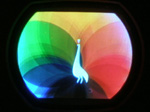
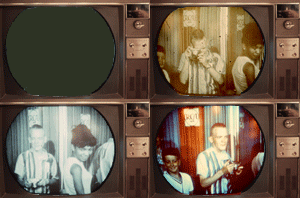
This evening I was surfing the VHF channels with my CT-100 and came across a game with players sporting big-time red jerseys. Grabbed my camera and added this example of a CT-100 displaying interesting red to my site.
http://home.att.net/~pldexnis/potpou...esh-green.html ------------------------------------------------------------------- FYI: Here's the intro to the page. The very non-orange 1953 NTSC red is very inefficient. Red phosphor is blasted with at least twice the energy of the other primary colors in the 15GP22. It is, therefore, common for the red gun in a 15GP22 to be weak compared to its blue and green partners. The procedure for getting good color balance cuts back on the blue and green during setup and leaves some headroom, so that, although the resulting video image will be less bright, it will nonetheless reproduce a picture with minimal electrical and phosphorescent distortion. Here is an over-the-air example of red from an eyeball-balanced CT-100 with a good red gun. Plans are forming to calibrate the set using instruments in early 2007 that will ensure, among other parameters, a correct Illuminate C white. 
|
|
#4
11-25-2006, 01:16 AM
|
||||
|
||||
|
Hi Pete,
Very nice pictures there. That true red is always amazing. I believe your reception is via an over air signal. My problem is my location has hills between me and the transmitter. So I depend on the cable feed. This tends to overload the front end of my CT-100 on high band vhf channels and is only marginally better on low band most of the time. The off air pix on my site were taken on those rare occastions when the cable & CT-100 were on speaking terms. VHS also distorts the picture. I plan to feed a dvd output to the set and see if that provides a better picture. Rooftop antenna is not an option. Any suggestions? -Steve D.
__________________
Please visit my CT-100, CTC-5, vintage color tv site: http://www.wtv-zone.com/Stevetek/
|
|
#5
11-25-2006, 08:38 AM
|
||||
|
||||
|
Quote:
The one time I had a cable connected to my CT-100 (for a few days almost a year ago; no cable box). http://home.att.net/~pldexnis/potpou...echannel78.jpg Unlike on the above example that was a UHF experiment, on some regular VHF channels, I was getting 'swirly' things not seen of a modern cable-ready set running alongside. But, here are two simple things that were effective clearing up a noisy picture in my set. Three-hundred-ohm twin lead is designed to be supported with standoffs. If you open the back and remove the top of the CT-100 cabinet, you can inspect the lead dress from the antenna connector on the rear to the KRK12C turret tuner. RCA used two plastic cable clamps to keep the lead from interacting with the rest of the chassis. If these clamps deteriorate, as do the similar plastic clamps on the delay line, the 300-ohm balanced line can flop around and generally not be where it should. I've replaced the long-gone clamps on my chassis with loops of spaghetti under the original clamp screws. A second and more important point is that the old tube sockets should probably all be changed in the IF strip and tuner. This of course is possible but not very practical, and it would increase the need for a full IF alignment. [ah, to go go back in time and watch the test and cal guys align a CTC2] A much easier and quick maintenance procedure for a possible marginal socket is simply to rock each IF tube in place in a rolling motion to introduce abrasion between the tube pins and the tube socket. Very simple and it works. I leave the tubes standing straight up and firmly seated against each socket. Yes the tubes are hard to reach and I most of the time do it with the power off. But you can get to the first two or so IF stages without sliding out the chassis. Although the tubes in the tuner have higher quality sockets, I re-seat the RF and IF amps there too and recently stabilized a microphonic-like ripple somewhere in the luminance path using this technique. A light tap on the floor next to the set intermittently caused the rippling effect, which is now in the 'repaired' category after simply re-seating the tubes (but it took a few times). You mentioned using a DVD to drive your set. Someone here on AudioKarma mentioned the 1938 Technicolor Robin Hood. Bought it and it makes a great color demo as the movie was shot in the three-film-strip technique using b&w film to record the color information. No dye deterioration possible; it makes for some spectacular vintage film color. For maximum fidelity I stay away from the composite domain with this arrangement. Use S-video to connect the DVD player to a late-model S-video VHS recorder, which is used to generate the modulated RF on channel 4. I'm hoping since it's an improved VHS format recorder that the manufacturer spent a bit more on the RF modulator too... but who knows. Anyway, the S-vid link has gotta help. Pete
|
| Audiokarma |
|
#6
11-25-2006, 01:10 PM
|
||||
|
||||
|
If the cable problem is really overload, you can fix it with an RF attenuator. RadioShack may have an adjustable one that would do the trick; however, I would be a little suspicious that the problem is somethng else. Can you see other channels' content running through the picture when watching the desired channel? This is a sign of overload, especially if the stupid cable company has not leveled all their signals recently.
|
|
#7
11-25-2006, 09:28 PM
|
||||
|
||||
|
Quote:
-Steve D.
__________________
Please visit my CT-100, CTC-5, vintage color tv site: http://www.wtv-zone.com/Stevetek/
|
|
#8
11-26-2006, 01:37 AM
|
|||
|
|||
|
I have had some issues with cable and/or VCRs overloading 1950s B&W sets. It seems that the passive AGC circuits in these sets are not as good as later active designs.
An example is an Admiral Bakelite set that I have. I did have it and three 1953 Hoffmans on the receiving end of one of the Radio Shack room to room TV transmitters. The Hoffmans have gain select swiches and work fine. The Admiral overloads with poor sync and buzz in the sound as the symptoms, along with some picture overloading. It has no gain select switch and works fine using the over-the-air signal from a local station. The adjustable Radio Shack attenuator has helped on another Admiral that I have, but I have not tried it on the bakelite set. I would thourougly check the AGC circuitry. (It has been my experience that GE Portacolor sets also do not work well on cable, I think that this is caused by cheap TV design. They do not work all that well on over the air signals.)
|
|
#9
11-26-2006, 03:04 PM
|
||||
|
||||
|
Quote:
|
|
#10
11-26-2006, 06:59 PM
|
||||
|
||||
|
Sets made before about 1970 were not designed to operate with adjacent channels, since the FCC never assigned them to the same market.
The bandpass circuits in the tuner still pass a significant amount of energy from the adjacent channels into the mixer, which can result in all sorts of unwanted products, many of which are visible in the picture. Cable, of course, uses all the VHF channels. For this reason many early sets will not operate well with a cable input, even if the tuner is hit with the proper level. I was in the cable TV business from the mid 60s, and it was always a challenge to get the older sets to work decently. The solution is to use some device that outputs only one channel, such as a VCR, cable box, or standalone modulator.
|
| Audiokarma |
|
#11
11-26-2006, 07:02 PM
|
|||
|
|||
|
Passive AGC just like the AM radio AGC. The signal is rectified and fed back to the tuner RF amp and a portion of the IF amplifier section. The strength of the signal directly determines the AGC strength with no amplification. Most, if not all, early TVs used this type of AGC.
Active AGC is amplified AGC. The rectified AGC voltage is amplified by prior to being sent back. Examples include keyed AGC, etc. This type of AGC was used in the 1960s and later. I have had no overloading trouble hooking a VCR or one of the Radio Shack receivers to sets built after about 1960. I have had issues hooking cable directly to some of these sets due to very poor tuner selectivity. The channels next to the desired chanels bleed through. This is the issue with the Portacolors. Even back in the 1960s, we lived next to a strong station on channel 10(ABC) and a weak one on channel 9(CBS). We had trouble viewing channel 9 due to the bleedtrough from channel 10 on the GE(one the worst TV manufacturers in the 1960s in my opinon) that we had. My grandfathers Emerson and the RCA roundie that we later got did not have this issue. To date, in hooking cable directly to a TV, I have had the best luck with the RCAs with the Nuvistor front end.
|
|
#12
11-27-2006, 05:30 PM
|
||||
|
||||
|
Thanks for the explanation.
|
|
#13
11-27-2006, 10:07 PM
|
||||
|
||||
|
Quote:
Let's see... flipping through the first two volumes of SAMS "Television Tube Location Guide" (published in 1950 and 1951 respectively), I see a few chassis with an AGC keyer, but mostly it's just a AGC rectifier. So, not many there. Skipping on to volumes 5 and 6 (1955 and 1956 respectively), I see quite a few tube layouts showing keyed AGC. Certainly not all of them, mind you, but it's a pretty decent percentage. Also, don't basically all color TVs have keyed AGC..? In the March 1960 issue of Consumer Reports, they had a review of "Minor Brand" Television Consoles for 1960, which includes the following text: "The fact is, for some years, CU has had a general rule that, if possible, no TV set is tested unless its circuitry includes three stages of Intermediate Frequency (IF) amplification, [...]; and keyed Automatic Gain Control (AGC)" [...] The context of this statement was to point out that some of these "minor brands" had not generally been included in CU's usual reviews because they did not offer sets meeting those two criteria. The companies not offering sets having keyed AGC in 1960 but reviewed anyway for this particular project were A-M-C, Muntz, Olympic, and Supre-Macy; all of which are definitely on the "low-end" side of the spectrum, and two of them are department store house-brands. [Even the Truetone (Western Auto house-brand) set reviewed in this project had keyed AGC and 3 IF stages. By the way, the other minor brands covered in this review were Andrea, Setchell-Carlson, and Trav-Ler, all of which also had keyed AGC and 3 IF stages, but those weren't low-end makes anyway so that's not surprising.] So, I'd take this to suggest that keyed AGC was pretty common well before 1960, except for low-end sets. (I'm sure even the major brands produced low-end sets without keyed AGC too) Anyway, I didn't intend to get pendantic here (sorry about that!)-- it just seemed like 1960 seemed rather late, so I did a little spot research to check. I could still be wrong though; I'm just reporting what I saw. I'd agree that keyed AGC wouldn't have become ubiquitous until after 1960, but I think it was still pretty common before then.
|
|
#14
11-27-2006, 11:22 PM
|
|||
|
|||
|
I am not sure when keyed AGC became common, just that the 1952 and 1954 Admirals that I had overload problems with did not have it. Neither do the 1953 Hoffmans that I have restored.
I chose 1960 as I knew that almost all sets had keyed AGC by then.
|
|
#15
11-28-2006, 05:09 PM
|
||||
|
||||
|
I agree that the red looks good... However, aren't we handicapped by viewing it on computer monitors?

__________________
From Captain Video, 1/4/2007 "It seems that Italian people are very prone to preserve antique stuff."
|
| Audiokarma |
 |
|
|







 Linear Mode

